

For general education, not medical advice. This guide can’t diagnose you or replace care from your own clinician. If you’re worried about a spot or symptom, see a board-certified dermatologist.
What Is a Skin Lesion?
A skin lesion is simply any spot, growth, or area of skin that looks different from the skin around it. By the time most adults reach their 50s and 60s, they have collected dozens of them — moles, age spots, and harmless bumps that accumulate over a lifetime of living in our skin.
The reassuring truth is that the large majority of skin lesions are benign (not cancer). The job of a skin cancer screening is to sort the common, harmless spots from the small number that need attention — and to do it before a problem becomes serious. This guide walks through 20 of the most common lesions a dermatologist evaluates during a skin check, grouped into skin cancers and precancers, benign moles and pigmented spots, and other common benign growths.
This guide covers growths and spots, not rashes (like eczema or psoriasis). It is educational and not a substitute for an in-person evaluation — any spot that is new, changing, bleeding, or simply concerning deserves a look from a dermatologist.
How Dermatologists Tell Benign From Concerning
Before the catalog, it helps to know what a clinician is actually looking for. A few principles cut across nearly every lesion:
- The ABCDEs — Asymmetry, Border irregularity, Color variation, Diameter over 6 mm, and Evolving (changing) — are the classic melanoma warning signs.
- The "ugly duckling" — the spot that stands out from your others, or behaves differently, often matters more than any single feature.
- Change over time — a stable spot is reassuring; a changing one warrants evaluation. This is why Total Body Photography and a baseline record are useful for people with many moles.
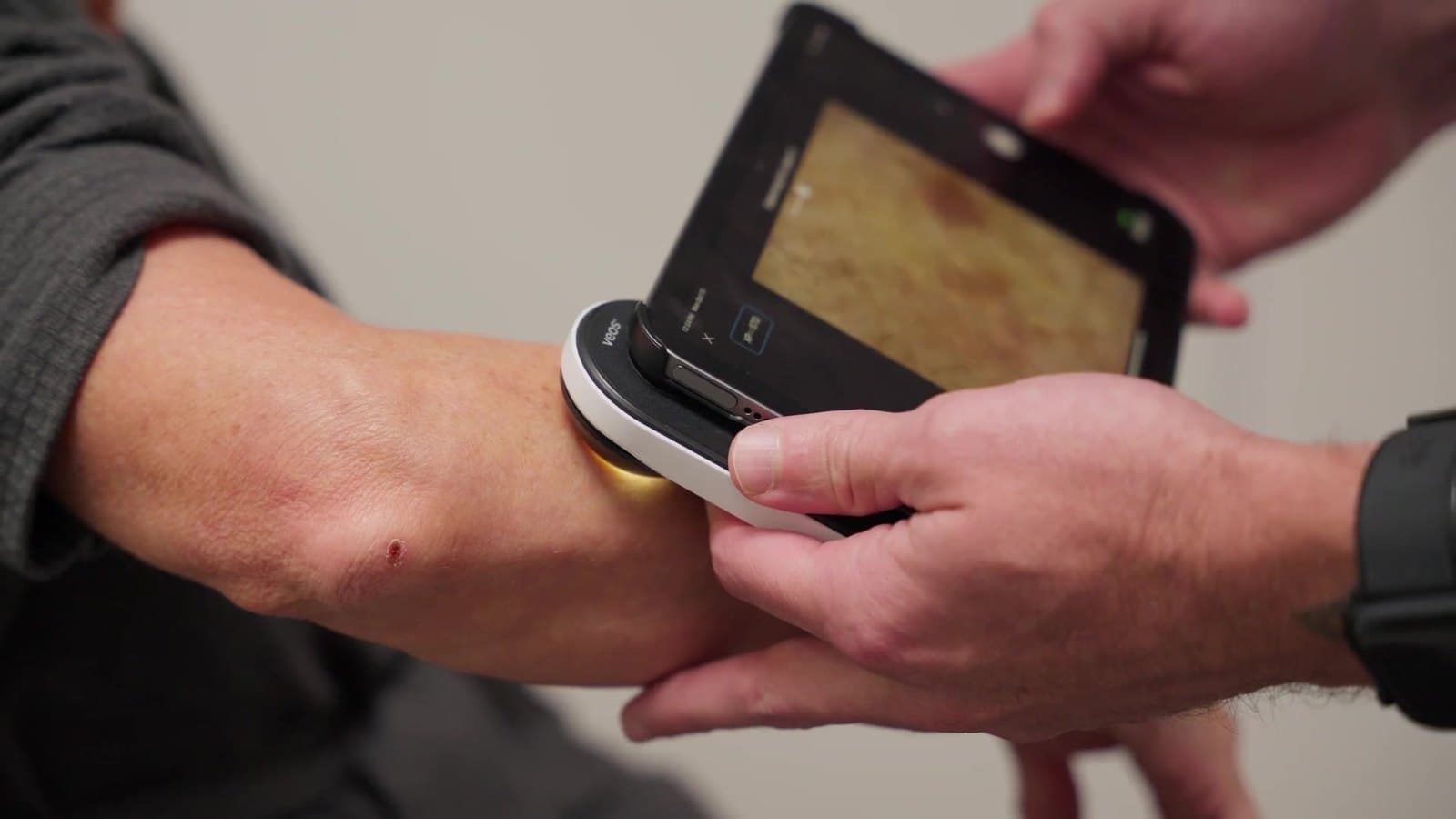
- Dermoscopy — a handheld magnifier with polarized light lets a dermatologist see patterns beneath the surface and confidently clear most benign spots without a biopsy.
When a lesion cannot be confidently called benign, a biopsy gives the definitive answer.
Skin Cancers and Precancers
These are the lesions a screening is designed to catch. Most are highly treatable when found early.
1. Melanoma — the most serious skin cancer, arising from pigment cells. It often looks like a new or changing mole with asymmetry, irregular borders, or multiple colors. Less common than other skin cancers but responsible for most skin cancer deaths, which is why early detection matters so much. Treated by surgical removal; early-stage melanoma is highly curable.
2. Basal cell carcinoma (BCC) — the most common skin cancer. Often a pearly or waxy bump, a pink patch, or a sore that won't heal on sun-exposed skin. Grows slowly and rarely spreads, but should be removed to prevent local damage.
3. Squamous cell carcinoma (SCC) — the second most common skin cancer. Typically a firm red nodule, or a rough, scaly, or crusted patch that may bleed. Curable when treated early; can spread if neglected.
4. Actinic keratosis (AK) — a precancer, not a cancer. Rough, scaly, sandpaper-like patches on sun-exposed skin. A percentage progress to SCC if untreated, so they are commonly treated with cryotherapy or field therapies.
5. Bowen's disease (SCC in situ) — the earliest, most superficial form of squamous cell carcinoma, confined to the top layer of skin. Looks like a persistent red, scaly, well-defined patch. Highly curable at this stage.
6. Keratoacanthoma — a rapidly growing, dome-shaped bump with a central keratin plug, often appearing over weeks. Considered a low-grade variant of squamous cell carcinoma; it is biopsied and removed rather than watched.
7. Lentigo maligna — an early, in-situ form of melanoma that develops slowly as a flat, irregular brown-to-tan patch on chronically sun-damaged skin (often the face) in older adults. Caught at this stage, it is highly treatable.
8. Merkel cell carcinoma — a rare but aggressive skin cancer, usually a firm, painless, fast-growing pink-red nodule on sun-exposed skin in older adults. Uncommon, but included here because prompt evaluation matters.
Benign Moles and Pigmented Spots
Pigmented (brown) spots are among the most common reasons people come in for a check — and the great majority are harmless.
9. Common mole (melanocytic nevus) — a uniform, round or oval brown spot with a smooth border. Most adults have 10–40. Stable moles are benign; it's the changing or "ugly duckling" mole that warrants attention.
10. Atypical (dysplastic) mole — a benign mole that looks irregular — larger, with uneven color or a fuzzy border. Having many is a marker of higher melanoma risk, but an individual atypical mole is benign and usually just monitored.
11. Solar lentigo (age spot / "liver spot") — a flat, uniformly tan-to-brown spot from cumulative sun exposure, common on the face, hands, and shoulders. Completely benign; treated only for cosmetic reasons.
12. Freckles (ephelides) — small, flat tan spots that darken with sun and fade in winter, common in fair-skinned people. Harmless, but a marker of sun sensitivity and sun exposure.
Other Common Benign Growths
These textured or raised growths are frequently mistaken for something worse — and are almost always harmless.
13. Seborrheic keratosis — the most common benign growth in adults over 30. Waxy, "stuck-on," wart-like brown-to-black bumps. Benign, though sometimes biopsied when a dark one needs to be told apart from melanoma. Removed only if irritated or for cosmetic reasons.
14. Cherry angioma — a small, smooth, bright-red dome made of tiny blood vessels. Extremely common with age and entirely benign.
15. Dermatofibroma — a firm, small, brown-to-pink nodule, often on the legs, that dimples inward when pinched. A benign reactive growth that usually needs no treatment.
16. Skin tag (acrochordon) — a soft, flesh-colored flap of skin on a narrow stalk, common in skin folds (neck, armpits, eyelids). Harmless; removed easily if irritated.
17. Sebaceous hyperplasia — small, soft, yellowish bumps with a central dimple, usually on the forehead and cheeks. Enlarged oil glands — benign, though they can resemble basal cell carcinoma and are sometimes checked closely.
18. Epidermoid cyst — a smooth, movable lump under the skin, sometimes with a central pore. Benign; treated if it becomes inflamed or bothersome.
19. Milia — tiny, firm white bumps, most often around the eyes and cheeks, where keratin is trapped near the surface. Harmless and common.
20. Wart (verruca) — a rough, raised growth caused by a virus (HPV), often on the hands and feet. Benign, but can be persistent; several treatments exist. Worth noting because warts are sometimes confused with other growths during a skin check.
When to See a Doctor
You don't need to diagnose your own spots — that's what a skin check is for. But it's worth being seen promptly if you notice a spot that:
- Is new and looks different from your other spots (the "ugly duckling")
- Is changing in size, shape, or color
- Bleeds, itches, crusts, or won't heal over several weeks
- Follows the ABCDE warning signs
If you have many moles, atypical moles, fair skin, significant sun exposure, or a personal or family history of skin cancer, regular skin cancer screening is the most reliable way to keep ahead of anything concerning — and to get reassurance about the many spots that are simply part of your skin's history.
References
- American Academy of Dermatology Association. Skin cancer types and benign growths. aad.org
- Luba MC, Bangs SA, Mohler AM, Stulberg DL. Common benign skin tumors. American Family Physician. 2015;92(7):601–607. aafp.org
- DermNet. Common benign skin lesions. dermnetnz.org
- American Cancer Society. What Is Melanoma Skin Cancer? cancer.org
- National Cancer Institute. Common Moles, Dysplastic Nevi, and Risk of Melanoma. cancer.gov
- Skin Cancer Foundation. Skin Cancer Information. skincancer.org
- Centers for Disease Control and Prevention. Skin Cancer: Basic Information. cdc.gov