
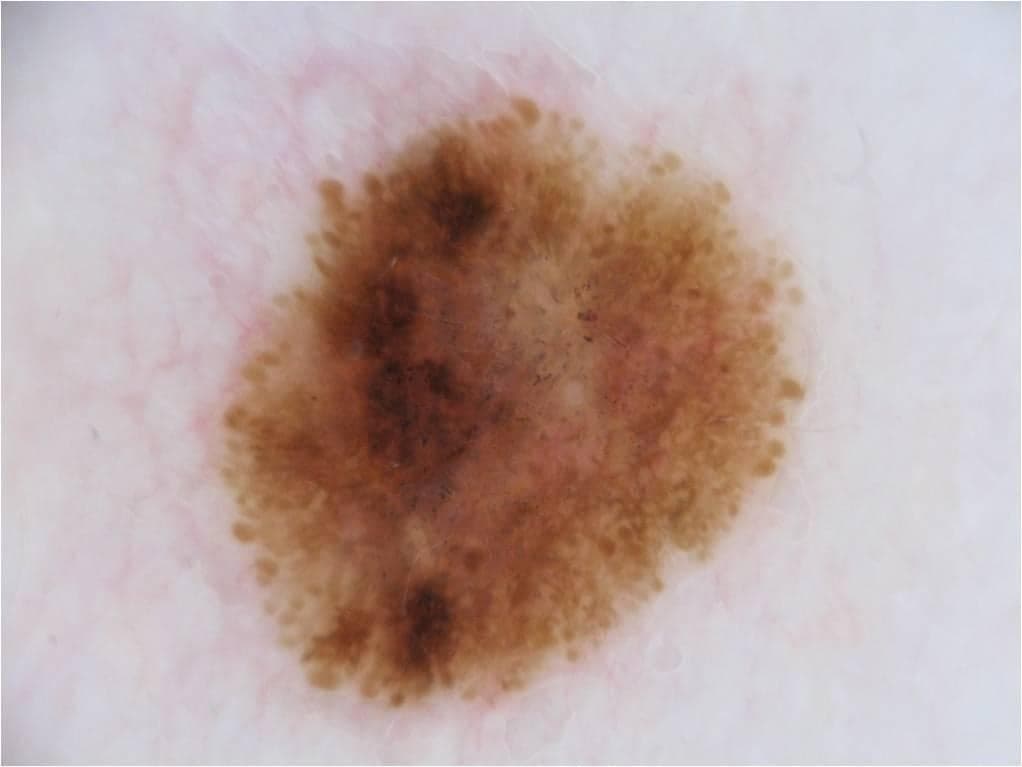

For general education, not medical advice. This guide can’t diagnose you or replace care from your own clinician. If you’re worried about a spot or symptom, see a board-certified dermatologist.
An atypical mole is a common mole that looks a little unusual. Doctors also call it a dysplastic nevus. It may be bigger than a pencil eraser, have more than one color, or have an uneven edge. It is harmless. So why do these moles matter? Not because one is likely to become cancer. They matter because having several is a sign to watch your skin. This guide covers what they mean, when a mole needs to come off, what home remedies really do, and when to get a spot checked.
Key points
- An atypical mole is a harmless mole that looks a little unusual. It is not cancer.1
- Having several atypical moles mostly means one thing: watch your skin closely, because your melanoma risk is higher. It does not mean the moles need to come off.2
- See a doctor before removing any spot yourself. A melanoma can look like an ordinary mole, and home removal can hide a skin cancer.3
What is an atypical mole?
A mole is a cluster of pigment cells. An atypical mole grew in a slightly uneven way, so it looks different from a plain mole. Under the microscope, it shares a few traits with melanoma. That is why it is called "dysplastic." But it is still harmless.1
Here is the key idea. An atypical mole is a risk marker, not a disease. People with many moles, especially atypical ones, have a higher chance of melanoma somewhere on the skin.2 So the point is to watch your skin. It is not to remove every unusual mole.
Signs to watch for
Use the ABCDE rules and the "ugly duckling" idea. A spot is worth checking if it shows:
- Asymmetry: one half does not match the other.
- Border that is uneven, scalloped, or blurred.
- Color that varies, with brown, black, tan, or other shades in one spot.
- Diameter larger than a pencil eraser (about 6 mm), though melanomas can be smaller.
- Evolving: any change in size, shape, color, or feel.
The "ugly duckling" is the mole that simply looks different from your others. Most of your moles tend to resemble each other, so the odd one out is worth a look.
How it's diagnosed
A skin doctor can usually spot an atypical mole on sight, often with a dermatoscope, a special magnifier. If a mole looks like it could be melanoma, the next step is a biopsy. When possible, the whole spot is removed so the lab can see all of it. Taking only part of a worrying mole can make the diagnosis harder.4
What to do about atypical moles
For most people the answer is: watch, do not remove. These moles are harmless. Removing them does not lower your melanoma risk. So the plan is regular skin checks, not cutting moles off. The comparison below shows the options, from everyday watching to when a procedure makes sense.
A few takeaways from the grid. Regular skin exams plus your own self-checks are the base. For higher-risk people, total body photography and digital follow-up help catch the mole that changes. They spare the ones that do not. Say a mole is removed and the lab calls it only mildly or moderately atypical. It usually does not need to be cut again, even if the edge was positive. Most skin doctors already do not re-cut these.5 The yield is very low.6 Taking more skin is mainly for the highest-grade, "severely" atypical moles. The right plan is a shared decision with your doctor.
Other options patients ask about
If you have searched online, you have seen creams, pens, and "natural" ways to remove a mole at home. Here is what the evidence actually shows, including the ones that can hurt you. None of these belongs in the comparison above, because none safely removes a mole and several are dangerous.
- Mole-removal creams, "mole correctors," and cautery or plasma pens. There is no good evidence these remove an atypical mole, and using them destroys the tissue a pathologist needs to tell a harmless mole from a melanoma.
- Apple cider vinegar and other DIY acids. No evidence they safely remove a mole, and a published case reports a chemical burn from putting apple cider vinegar on the skin.7
- "Black salve" (an escharotic paste). This one is the most dangerous. A pathology review of moles treated with black salve found burns, scarring, and dead tissue, and in some cases a skin cancer was hidden underneath the damage.8 It can burn your skin while masking a cancer.
- Cutting, banding, or "lasering it off" at home. No evidence, and it removes the very tissue needed to rule out melanoma, while risking bleeding, infection, and scarring.
The real reason to skip all of these: an atypical mole can be hard to tell from melanoma by eye, so destroying a spot at home can hide a skin cancer and remove the proof a doctor needs.
Do atypical moles turn into melanoma?
Almost always, no. Any single atypical mole is very unlikely to become melanoma. Here is the part that surprises people: most melanomas do not start in a mole you already have. When melanomas are studied, only about 30% are found next to a mole. That means about 70% show up on normal-looking skin.3
So removing all your atypical moles "just in case" does not prevent melanoma. Watching your whole skin matters more than chasing single moles.1 The thing to act on is change. A new spot, or a mole that starts to look or feel different, should be checked. Get it looked at, and biopsied if needed, before anything is removed.
When to see a doctor
Have a spot checked if it is new, changing, bleeding, itching, or looks different from your other moles. Do you have many moles, several atypical ones, or a family history of melanoma? Ask your skin doctor how often to come in, and whether baseline photos make sense for you. Most visits are quick and reassuring. The goal is to catch the rare problem mole early.
Worried about a spot?
SpotDoc offers full-body skin cancer screening in Brownwood Square, The Villages. No referral needed for most plans.
Frequently asked questions
Are atypical moles cancer? No. They are harmless moles that look a little unusual. They are not cancer.
Do my atypical moles need to be removed? Usually not. Removal is for a specific mole that looks suspicious, not for prevention. Removing harmless moles does not lower your melanoma risk.
Should I just have all of them taken off to be safe? No. Most melanomas appear on normal skin, not in an existing mole, so removing your moles cannot prevent them. Watching your whole skin is the better plan.
My mole was removed and the edge was "positive." Do I need surgery again? Often not. If it was only mildly or moderately atypical with nothing visibly left behind, watching it is a reasonable option, and re-cutting rarely changes anything. Your dermatologist will tell you if yours is one of the higher-grade moles where taking a little more skin makes sense.
Can I remove a mole at home with a cream, apple cider vinegar, or "black salve"? No. These do not safely remove moles, they can burn and scar your skin, and they can hide a skin cancer by destroying the tissue a doctor needs to check. Black salve in particular has masked cancers under the damage it causes.
How often should I get my skin checked? It depends on your moles and your history. People with many moles, atypical moles, or a melanoma history are usually checked more often. Your dermatologist sets the schedule.
Questions to ask your dermatologist
- Given how many moles I have, how often should I have a skin exam?
- Would baseline photos of my skin help track changes over time?
- This mole was atypical. Does it need anything more, or do we just watch it?
- What changes should make me call the office sooner?
- How do I check my own skin between visits?
Reviewed by Tyler Long, DO. Last reviewed June 2026.
Update log
How this guide has changed since it was first published.
- September 8, 2026Guide published.
References
Every statement on this page is backed by the peer-reviewed sources below — each links to the original study. Numbers match the citations in the text and the grids above.
- Perkins A, Duffy RL. Atypical moles: diagnosis and management. Am Fam Physician. 2015;91(11):762–767.
- Gandini S, Sera F, Cattaruzza MS, et al. Meta-analysis of risk factors for cutaneous melanoma: I. Common and atypical naevi. Eur J Cancer. 2005;41(1):28–44.View source
- Dessinioti C, Befon A, Stratigos AJ. The association of nevus-associated melanoma with common or dysplastic melanocytic nevus: a systematic review and meta-analysis. Cancers (Basel). 2023;15(3):856.View source
- Fleming NH, Egbert BM, Kim J, Swetter SM. Reexamining the threshold for reexcision of histologically transected dysplastic nevi. JAMA Dermatol. 2016;152(12):1327–1334.View source
- Sapra P, Rosen C, Siddha S, Lynde CW. Dysplastic nevus: management by Canadian dermatologists. J Cutan Med Surg. 2015;19(5):457–463.View source
- Strazzula L, Vedak P, Hoang MP, Sober A, Tsao H, Kroshinsky D. The utility of re-excising mildly and moderately dysplastic nevi: a retrospective analysis. J Am Acad Dermatol. 2014;71(6):1071–1076.View source
- Bunick CG, Lott JP, Warren CB, Galan A, Bolognia J, King BA. Chemical burn from topical apple cider vinegar. J Am Acad Dermatol. 2012;67(4):e143–e144.View source
- Leecy TN, Beer TW, Harvey NT, et al. Histopathological features associated with application of black salve to cutaneous lesions: a series of 16 cases and review of the literature. Pathology. 2013;45(7):670–674.View source
- Salerni G, Carrera C, Lovatto L, et al. Benefits of total body photography and digital dermatoscopy ("two-step method of digital follow-up") in the early diagnosis of melanoma in patients at high risk for melanoma. J Am Acad Dermatol. 2011;67(1):e17–e27.View source
- Hornung A, Steeb T, Wessely A, et al. The value of total body photography for the early detection of melanoma: a systematic review. Int J Environ Res Public Health. 2021;18(4):1726.View source
- Nguyen J, Doolan BJ, Pan Y, et al. Evaluation of dynamic dermoscopic features of melanoma and benign naevi by sequential digital dermoscopic imaging and total body photography in a high-risk Australian cohort. Australas J Dermatol. 2023;64(1):67–79.View source
- Kim CC, Swetter SM, Curiel-Lewandrowski C, et al. Addressing the knowledge gap in clinical recommendations for management and complete excision of clinically atypical nevi/dysplastic nevi: Pigmented Lesion Subcommittee consensus statement. JAMA Dermatol. 2015;151(2):212–218.View source
- Hiscox B, Hardin MR, Orengo IF, Rosen T, Mir M, Diwan AH. Recurrence of moderately dysplastic nevi with positive histologic margins. J Am Acad Dermatol. 2016;76(3):527–530.View source
- Engeln K, Peters K, Ho J, et al. Dysplastic nevi with severe atypia: long-term outcomes in patients with and without re-excision. J Am Acad Dermatol. 2016;76(2):244–249.View source