
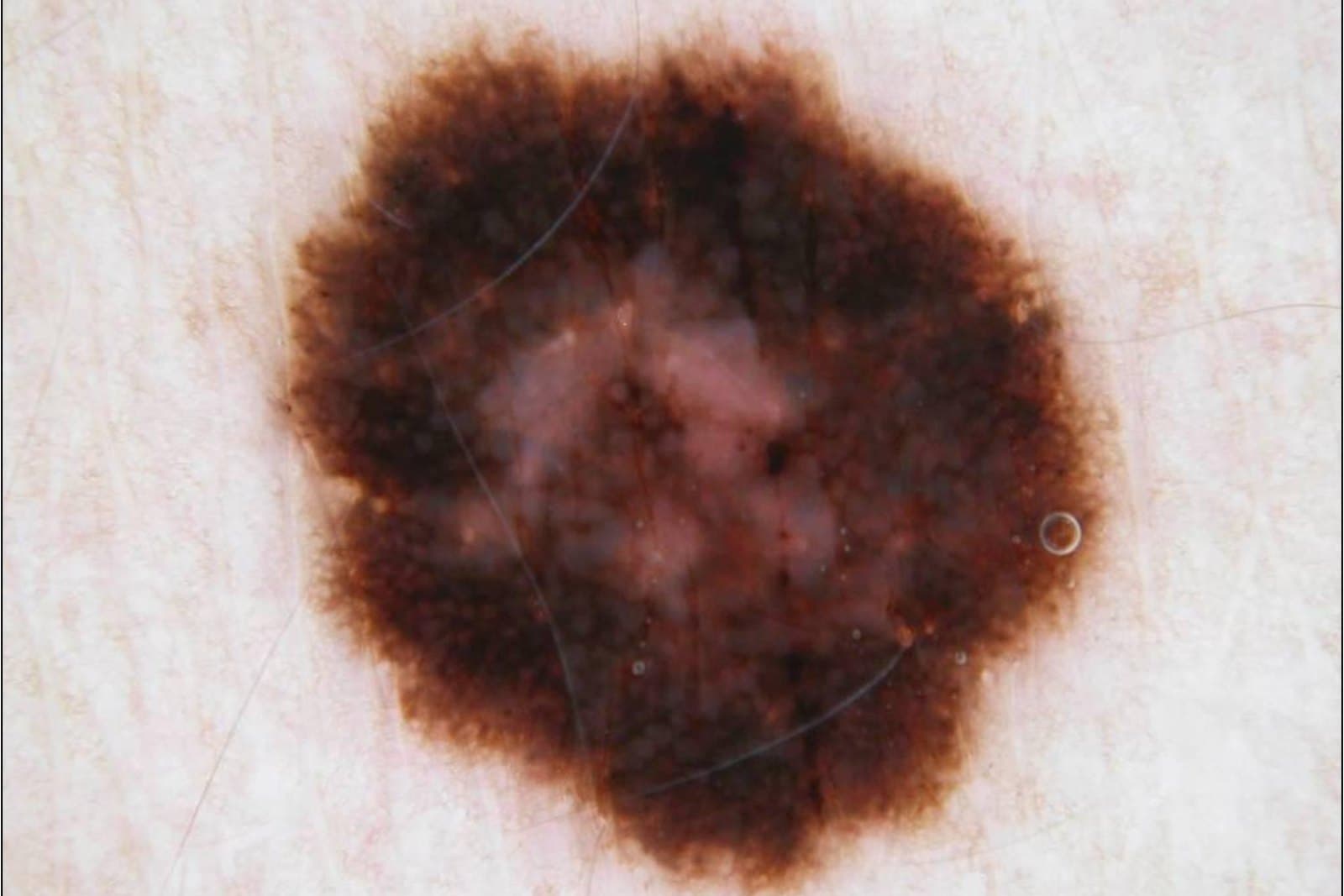

For general education, not medical advice. This guide can’t diagnose you or replace care from your own clinician. If you’re worried about a spot or symptom, see a board-certified dermatologist.
Melanoma is the most serious common skin cancer because it can spread to other parts of the body. But here is the hopeful part. Most melanomas are caught early, and an early melanoma is highly treatable.1 This guide is an overview of the whole melanoma family. It explains the types and stages, so you can see where a diagnosis fits, then walks through how treatment changes from one stage to the next.
Key points
- Melanoma is a family of cancers, from melanoma in situ (top layer only, almost always curable) to invasive and advanced disease. Where a melanoma falls drives everything that follows.
- Most melanoma is caught early and cured with a single surgery. Advanced disease has powerful newer treatments, given by oncology.2
- Outlook depends most on how early it is found. A new or changing mole is the key warning sign.
What is melanoma?
Melanoma is a cancer of the melanocytes, the cells that give skin its color. It can appear in an existing mole or as a new spot. It shows up most on sun-exposed skin, but it can occur anywhere, including the soles, palms, and nails. The main risk factor is ultraviolet light, along with having many moles, fair skin, and a family history. What sets melanoma apart from other skin cancers is that it is more likely to spread if it is not caught early.
The melanoma family: where a diagnosis fits
Melanoma is not one thing. The biggest difference between melanomas is how deep the cancer has grown, and that is what places a diagnosis on the map below:
- Melanoma in situ (Stage 0). The earliest form. The cancer cells sit only in the top layer of skin and have not grown deeper, so it essentially cannot spread and is almost always cured by removing it. The melanoma in situ guide covers this. A common in-situ type on chronically sun-damaged skin, often on the face in older adults, is lentigo maligna (see the lentigo maligna guide).
- Invasive melanoma (Stage I–II). The melanoma has grown down into the skin but has not spread. It is staged mainly by its depth (the Breslow thickness). Surgery is the main treatment, and most are cured.
- Advanced melanoma (Stage III–IV). The melanoma has spread, either to nearby lymph nodes (Stage III) or to distant parts of the body (Stage IV). Treatment adds systemic therapy, given by oncology.
Melanoma also comes in subtypes, named for how it looks and grows: superficial spreading (the most common, spreads outward first), nodular (grows downward faster, so it can be thicker when found), lentigo maligna (on sun-damaged skin in older adults), and acral lentiginous (on the palms, soles, or under the nails). For treatment, the stage matters more than the subtype, but the subtype affects where to look and how it appears.
Warning signs: the ABCDEs
A new or changing mole is the most important clue. The ABCDE guide helps spot a worrisome mole:
- Asymmetry: one half does not match the other
- Border: edges are ragged, notched, or blurred
- Color: more than one color, or uneven color
- Diameter: larger than a pencil eraser (about 6 mm), though melanomas can be smaller
- Evolving: changing in size, shape, color, or feel, or a new spot
Another simple clue is the "ugly duckling": a mole that looks different from your others. Anything new, changing, bleeding, or itchy is worth getting checked.
How it is diagnosed and staged
A clinician examines the spot, often with a handheld magnifier (dermoscopy). Any suspicious lesion is removed and checked under the microscope (a biopsy).2
If it is melanoma, the most important number is the Breslow thickness. This is how deep the melanoma reaches into the skin, in millimeters. Thin melanomas have the best outlook. Thickness, plus whether the surface is broken (ulceration), sets the stage, which guides treatment. The current staging system (AJCC 8th edition) is built so that the small share of higher-stage tumors accounts for most of the serious outcomes.3
Treatment, by stage
Treatment follows the stage. Here is the short version of each; the deeper guides cover the details.
Melanoma in situ
Early, surface-only melanoma is removed by surgery with a narrow margin, and it is almost always cured. For lentigo maligna on the face, when surgery is difficult, nonsurgical options such as a skin cream or radiation are sometimes used. The melanoma in situ guide covers this in full.
Invasive melanoma
For invasive melanoma, surgery is the main treatment. The melanoma is removed with a margin of normal skin matched to how deep it is, and most are cured.45 (A dedicated invasive melanoma guide, with the full treatment detail, is in progress.)
Beyond surgery, a few other treatments are used in selected cases and are led by oncology. They are not first-line, but worth knowing about:
- Radiation can be added after surgery in certain higher-risk situations, used when surgery is not a good option, or given to ease symptoms.2
- Neoadjuvant immunotherapy means immunotherapy given before surgery, for higher-risk melanoma that can still be removed. It is a newer approach, studied in recent trials and used in selected patients.6
- Intralesional or limb-directed therapy uses an injection into the tumor, or treatment delivered to an affected arm or leg. It can be used when melanoma comes back in the skin near the original site ("in-transit" disease).7
Checking the lymph nodes
For thicker melanomas, a sentinel lymph node biopsy may be offered. This checks the first lymph node the melanoma would drain to. It is mainly a staging tool: it gives the strongest single clue about outlook and helps decide whether more treatment is considered.8 It is not a treatment that extends survival for everyone. If that node has melanoma, doctors now often watch the area with ultrasound rather than removing all the nodes, because removing them did not improve survival in a large trial.9
Advanced melanoma
For advanced melanoma (spread to nodes or beyond), treatment is systemic and given by oncology:
- Immunotherapy helps the immune system attack the melanoma. After surgery for higher-risk disease it lowers the chance of return, and for spread melanoma it has meaningfully improved long-term survival.1011
- Targeted pills (BRAF/MEK inhibitors) are an option for the roughly half of melanomas that carry a BRAF gene change, found by gene testing.12
This care is coordinated by referral to a medical oncologist.
Lowering your risk and catching it early
Most melanoma risk traces back to ultraviolet light, so sun protection lowers the chance of new melanoma over time.13 Because outlook depends so much on early detection, knowing your own skin and getting new or changing spots checked are the most powerful things you can do.
Ultraviolet light — especially intense, intermittent sun and sunburns — is a leading driver of melanoma risk, so reducing UV exposure lowers it. In a randomized trial, regular sunscreen use also lowered the rate of new melanoma over long-term follow-up.
Early detection is the single biggest driver of melanoma outcome; a new or changing mole is the key warning sign.
Whole-body prevention, separate from the spot treatments above. “No effect” means good trials found no benefit. Every source is PubMed-verified; not medical advice.
Checking your own skin regularly, and having higher-risk skin watched by a clinician, helps catch melanoma when it is thin and most treatable. See the skin self-exam guide for how to do it.
When to see a doctor
See a clinician for any mole or spot that is new, changing, asymmetric, multi-colored, growing, bleeding, or simply looks different from your others. Do not wait for it to hurt. If you have many moles, atypical (dysplastic) moles, fair skin, or a family history of melanoma, regular skin checks are especially worthwhile.
Worried about a spot?
SpotDoc offers full-body skin cancer screening in Brownwood Square, The Villages. No referral needed for most plans.
Frequently asked questions
What is the difference between melanoma in situ and invasive melanoma? Melanoma in situ sits only in the top layer of skin, so it essentially cannot spread and is almost always cured by removing it. Invasive melanoma has grown deeper into the skin, which is why it is staged by depth and why it can, if not caught early, spread. They are treated differently, so it is worth knowing which one you have.
Is melanoma curable? Most early melanomas are cured with a single surgery. Outlook depends most on how early it is found and how thin the melanoma is, which is why checking new or changing spots matters so much.2
Will I need chemotherapy? For most early melanoma, no. Treatment is a surgical removal in the office. Advanced disease is treated with immunotherapy or targeted pills, not old-style chemotherapy, and that care is given by oncology.11
What is a sentinel lymph node biopsy? It checks the first lymph node the melanoma would drain to. It is mainly a staging tool that gives the strongest clue about outlook and helps guide further treatment, offered for thicker melanomas.8 If that node is involved, watching the nodes with ultrasound is now often chosen, since removing all of them did not improve survival in a trial.9
How wide a margin will be removed? The margin is matched to how deep the melanoma is: thin melanomas need a narrower margin than thicker ones. Trials show a margin matched to the tumor is as safe as a wider one.5 Your clinician will explain the plan for your melanoma.
Questions to ask your clinician
- Is my melanoma in situ, invasive, or advanced, and what stage is it?
- How thick is it, and do I need a sentinel lymph node biopsy?
- What margin will be removed, and what will the scar look like?
- Do I need to see an oncologist, and for what?
- How often should I have skin checks now, and what should I watch for?
Melanoma is the most serious skin cancer, but early detection changes everything. Related guides cover melanoma in situ, lentigo maligna, atypical (dysplastic) moles, and surgical excision. A thorough skin cancer screening is the place to start.
Reviewed by Tyler Long, DO. Last reviewed 2026-06-24.
Update log
How this guide has changed since it was first published.
- August 4, 2026Guide published.
References
Every statement on this page is backed by the peer-reviewed sources below — each links to the original study. Numbers match the citations in the text and the grids above.
- Siegel RL, Giaquinto AN, Jemal A. Cancer statistics, 2024. CA Cancer J Clin. 2024;74(1):12–49.View source
- Swetter SM, Tsao H, Bichakjian CK, et al. Guidelines of care for the management of primary cutaneous melanoma. J Am Acad Dermatol. 2019;80(1):208–250.View source
- Gershenwald JE, Scolyer RA, Hess KR, et al. Melanoma staging: Evidence-based changes in the AJCC eighth edition cancer staging manual. CA Cancer J Clin. 2017;67(6):472–492.View source
- Thomas JM, Newton-Bishop J, A’Hern R, et al. Excision margins in high-risk malignant melanoma. N Engl J Med. 2004;350(8):757–766.View source
- Gillgren P, Drzewiecki KT, Niin M, et al. 2-cm versus 4-cm surgical excision margins for primary cutaneous melanoma thicker than 2 mm: a randomised, multicentre trial. Lancet. 2011;378(9803):1635–1642.View source
- Patel SP, Othus M, Chen Y, et al. Neoadjuvant–adjuvant or adjuvant-only pembrolizumab in advanced melanoma. N Engl J Med. 2023;388(9):813–823.View source
- Andtbacka RHI, Kaufman HL, Collichio F, et al. Talimogene laherparepvec improves durable response rate in patients with advanced melanoma. J Clin Oncol. 2015;33(25):2780–2788.View source
- Morton DL, Thompson JF, Cochran AJ, et al. Final trial report of sentinel-node biopsy versus nodal observation in melanoma. N Engl J Med. 2014;370(7):599–609.View source
- Faries MB, Thompson JF, Cochran AJ, et al. Completion dissection or observation for sentinel-node metastasis in melanoma. N Engl J Med. 2017;376(23):2211–2222.View source
- Weber J, Mandala M, Del Vecchio M, et al. Adjuvant nivolumab versus ipilimumab in resected stage III or IV melanoma. N Engl J Med. 2017;377(19):1824–1835.View source
- Larkin J, Chiarion-Sileni V, Gonzalez R, et al. Five-year survival with combined nivolumab and ipilimumab in advanced melanoma. N Engl J Med. 2019;381(16):1535–1546.View source
- Robert C, Grob JJ, Stroyakovskiy D, et al. Five-year outcomes with dabrafenib plus trametinib in metastatic melanoma. N Engl J Med. 2019;381(7):626–636.View source
- Green AC, Williams GM, Logan V, Strutton GM. Reduced melanoma after regular sunscreen use: randomized trial follow-up. J Clin Oncol. 2011;29(3):257–263.View source