

For general education, not medical advice. This guide can’t diagnose you or replace care from your own clinician. If you’re worried about a spot or symptom, see a board-certified dermatologist.
A seborrheic keratosis is a common skin growth that shows up as we get older. It is harmless. People sometimes call these "age spots" or "barnacles of aging." They can look a little scary because they grow, darken, and feel rough, but they are not cancer and they do not turn into cancer. This guide explains what they are, when it makes sense to remove one, what the popular home remedies really do, and the one reason it is worth having a new spot checked.
Key points
- A seborrheic keratosis is a common, harmless growth. It is not a cancer and it does not turn into one.1
- You do not need to treat it. People have one removed mainly for looks, or if it catches on clothing, rubs, or itches.2
- See a doctor before removing any spot yourself, because a melanoma can sometimes look like a harmless growth.3
What is a seborrheic keratosis?
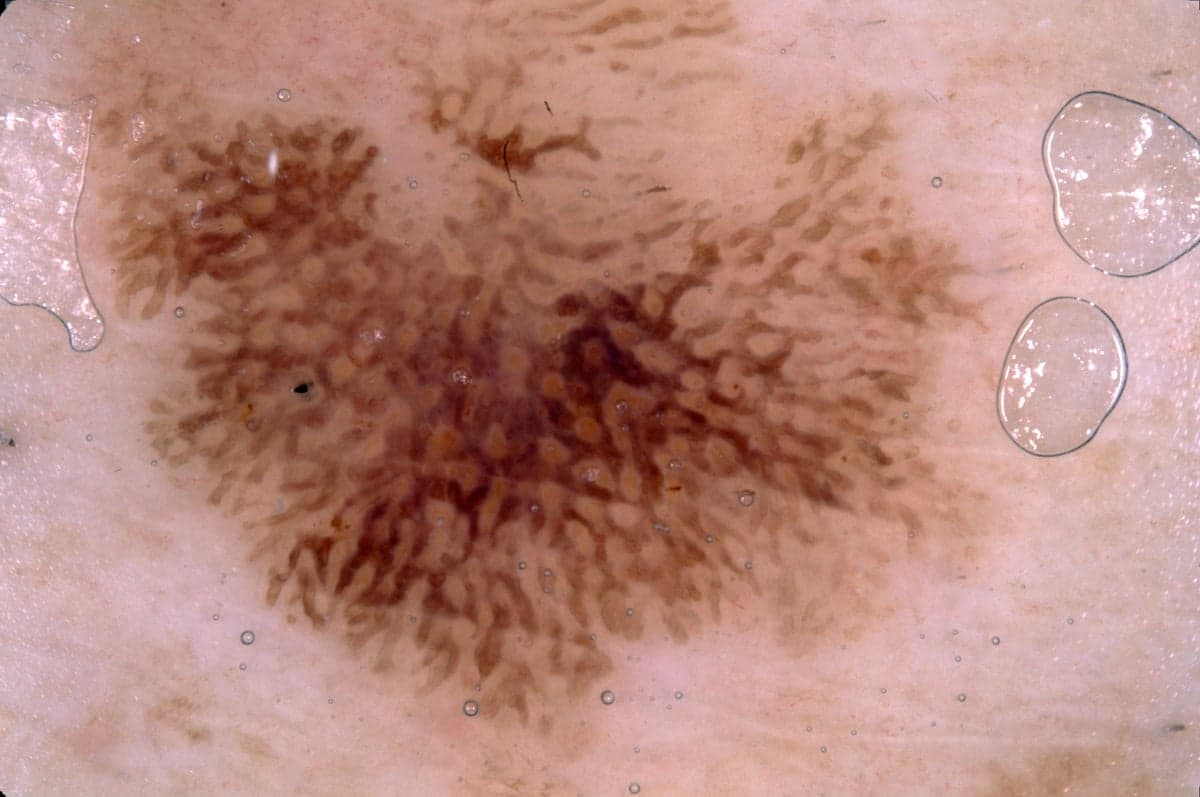
A seborrheic keratosis is an overgrowth of normal skin cells. It builds up on the surface, so it often looks "stuck on," like a dab of candle wax or a small barnacle. They are very common after age 50, and most people who have one will get more over the years.1
The cause is mostly age and family history. These growths are not caused by sun damage in the way that precancers are, and they are not contagious. Above all, a true seborrheic keratosis is benign, which means harmless.
Signs to watch for
Seborrheic keratoses can show up almost anywhere except the palms and soles. They are common on the face, scalp, chest, back, and stomach.
A typical growth:
- Looks "stuck on," as if it could be peeled off (though you should not try).
- Is tan, brown, or black, sometimes more than one color.
- Has a rough, waxy, or warty surface.
- Is usually painless, but can itch or get sore when clothing rubs it.
Most are easy to recognize. The reason to pay attention is that some look like other spots, including skin cancer, which is covered below.
How is it diagnosed?
A dermatologist can usually recognize a seborrheic keratosis on sight, often with a dermatoscope, a special magnifier that shows the surface pattern.4
When a growth looks unusual, has changed, or cannot be told apart from a skin cancer, the safe step is a small skin biopsy. A sample is removed and checked under a microscope. That is the only way to be certain.2
Do you need to treat it?
Usually, no. Because these growths are harmless, the honest answer is that most need no treatment at all. People choose to have one removed for a few reasons: they do not like how it looks, it catches on clothing or jewelry, or it itches and gets irritated.
When a growth is removed, there are a few simple in-office ways to do it. None is the single "best" choice. The right one depends on the growth, where it is, and whether your doctor wants to send the tissue to a lab to be sure.
The grid above compares the common removal methods. For most people it is a shared decision with the dermatologist. If there is any doubt that a growth is harmless, shaving or scraping is preferred because the tissue can be checked. Insurance often does not cover removing a harmless growth for looks alone, so ask about cost ahead of time.
Other options patients ask about
If you have searched online, you have seen home remedies and "natural" removers for these growths. Here is what the evidence actually shows, including the ones that can hurt you.
- Prescription creams (such as tazarotene). A few small studies suggest some prescription creams can fade these growths over weeks. The evidence is early and limited, so they are not a first choice, but they are a real option to discuss.5
- Apple cider vinegar. There is no good evidence it removes a growth, and it has caused chemical burns when put on the skin.6 Skip it.
- Tea tree oil. No evidence it helps, and it is a common cause of an itchy skin allergy.7
- Regular drugstore hydrogen peroxide (3%). This is not the same as the prescription 40% liquid a doctor uses. There is no evidence the household strength removes these growths.8
- At-home freeze kits, "mole and skin tag" removers, or scraping it off. There is no evidence these work on seborrheic keratoses, and they can scar your skin.
The most important reason to skip do-it-yourself removal is safety. A melanoma can look like a harmless growth, and in one study many such melanomas were first mistaken for benign spots.3 If you destroy a spot at home, you can hide a skin cancer and remove the very tissue a doctor needs to diagnose it.9
Can a seborrheic keratosis turn into cancer?
A true seborrheic keratosis is harmless and does not turn into melanoma.1 There are two reasons to still have a doctor confirm a spot:
- A skin cancer can look like one. Melanoma and other skin cancers can copy the look of a harmless growth, which is why a new, changing, bleeding, or "different from the rest" spot should be checked.3
- Very rarely, a cancer can grow within a large, long-standing growth in older skin. This is uncommon, but it is another reason an unusual or changing growth is worth a look.10
Both reasons point to the same simple rule: let a doctor confirm a spot is harmless rather than assuming it.
When to see a doctor
Have a spot checked if it is new, changing, bleeding, painful, or looks different from your other spots. Also see a doctor if a growth gets caught and irritated often, or if you simply want to know for sure what it is. If many new growths appear suddenly over a short time, mention it, as that is uncommon and worth a quick look.
The visit is usually quick and reassuring. Most of the time the news is good, and you leave knowing the spot is harmless.
Worried about a spot?
SpotDoc offers full-body skin cancer screening in Brownwood Square, The Villages. No referral needed for most plans.
Frequently asked questions
Is a seborrheic keratosis skin cancer? No. It is a harmless growth. It is not cancer and it does not turn into cancer.
Will it turn into melanoma? No, a true seborrheic keratosis does not become melanoma. The catch is that a melanoma can look like one, so a new or changing spot should be checked to be sure.
Do I have to remove it? No. Removal is a choice, not a medical need. People do it for looks or when a growth rubs, catches, or itches.
Does apple cider vinegar or tea tree oil remove them? There is no good evidence either one removes these growths. Apple cider vinegar has caused chemical burns on skin, and tea tree oil often causes an itchy allergy. It is safer to skip them.
Can I freeze or scrape it off at home? It is not a good idea. Home kits can scar your skin, and treating a spot yourself can hide a skin cancer and remove the tissue a doctor would need to diagnose it.
Why did I suddenly get so many? Getting more of them with age is normal and runs in families. A sudden burst of many new growths in a short time is uncommon, so mention that to your doctor.
Will it come back after removal? A growth that is fully removed usually does not return in the same spot, but you will likely keep forming new ones elsewhere over time. That is normal and not a sign of anything wrong.
Questions to ask your dermatologist
- Is this growth harmless, or should it be sampled to be sure?
- If I want it removed, which method fits this growth and my skin?
- Will removal leave a mark, and could the growth come back?
- I have a spot that has changed. Should it be biopsied?
- How often should I have my skin checked?
Reviewed by Tyler Long, DO. Last updated June 2026.
Update log
How this guide has changed since it was first published.
- October 6, 2026Guide published.
References
Every statement on this page is backed by the peer-reviewed sources below — each links to the original study. Numbers match the citations in the text and the grids above.
- Hafner C, Vogt T. Seborrheic keratosis. J Dtsch Dermatol Ges. 2008;6(8):664–677.View source
- Karadag AS, Parish LC. The status of the seborrheic keratosis. Clin Dermatol. 2018;36(2):275–277.View source
- Carrera C, Segura S, Aguilera P, et al. Dermoscopy improves the diagnostic accuracy of melanomas clinically resembling seborrheic keratosis: cross-sectional study. Dermatology. 2018;233(6):471–479.View source
- Moscarella E, Brancaccio G, Briatico G, et al. Differential Diagnosis and Management on Seborrheic Keratosis in Elderly Patients. Clin Cosmet Investig Dermatol. 2021;14:395–406.View source
- Herron MD, Bowen AR, Krueger GG. Seborrheic keratoses: a study comparing the standard cryosurgery with topical calcipotriene, topical tazarotene, and topical imiquimod. Int J Dermatol. 2004;43(4):300–302.View source
- Bunick CG, Lott JP, Warren CB, Galan A, Bolognia J, King BA. Chemical burn from topical apple cider vinegar. J Am Acad Dermatol. 2012;67(4):e143–e144.View source
- Hartford O, Zug KA. Tea tree oil. Cutis. 2005;76(3):178–180.
- Baumann LS, Blauvelt A, Draelos ZD, et al. Safety and efficacy of hydrogen peroxide topical solution, 40% (w/w), in patients with seborrheic keratoses: results from 2 identical, randomized, double-blind, placebo-controlled, phase 3 studies. J Am Acad Dermatol. 2018;79(5):869–877.View source
- Braga JCT, Scope A, Klaz I, et al. Melanoma mimicking seborrheic keratosis: an error of perception precluding correct dermoscopic diagnosis. J Am Acad Dermatol. 2008;58(5):875–880.View source
- Goto K, Ogawa K, Hishima T, et al. Seborrheic keratosis with malignant transformation (invasive or noninvasive squamous cell carcinoma arising in seborrheic keratosis): a clinicopathologic and immunohistochemical study of 11 cases. Am J Dermatopathol. 2022;44(12):891–899.View source
- Brodsky J. Management of benign skin lesions commonly affecting the face: actinic keratosis, seborrheic keratosis, and rosacea. Curr Opin Otolaryngol Head Neck Surg. 2009;17(4):315–320.View source
- DuBois JC, Jarratt M, Beger BB, et al. A-101, a proprietary topical formulation of high-concentration hydrogen peroxide solution: a randomized, double-blind, vehicle-controlled, parallel group study of the dose-response profile in subjects with seborrheic keratosis of the face. Dermatol Surg. 2018;44(3):330–340.View source
- Natarelli N, Krenitsky A, Hennessy K, Moore S, Grichnik J. Efficacy and safety of topical treatments for seborrheic keratoses: a systematic review. J Dermatolog Treat. 2022;34(1):2133532.View source