

For general education, not medical advice. This guide can’t diagnose you or replace care from your own clinician. If you’re worried about a spot or symptom, see a board-certified dermatologist.
Total body photography, often shortened to TBP, is a way to photograph almost all of your skin in one session and keep it as a map. At a later visit, a dermatologist can compare new pictures against that map to see what is new and what has changed. This page explains what the technology is, how it grew from flat photos to a 3D map, where the research is strongest, and what it cannot do. The close-up analysis of those images is a separate step, and it has its own page.
Key points
- Total body photography is an imaging step. It makes a whole-body map so a new spot or a change stands out later.1
- It helps most for people at higher risk of melanoma, where a new or changing spot is the main warning sign.2
- Photography is the first step, not the whole exam. A dermatologist still examines your skin and takes a biopsy when a spot looks suspicious.3
What total body photography is
The idea is simple. Melanoma is often easiest to catch not from how one mole looks on a single day, but from how a spot changes over time, or from a new spot that does not match your other moles. A photographic map gives the dermatologist a fixed reference instead of relying on memory.
A modern system captures the skin from many angles at once and builds a 3D model you can rotate on a screen. Each mole sits at a fixed place on the model, so it can be found again and measured at the next visit. The images are stored as your baseline.
From film to a 3D map
The tools have changed a lot in twenty years. The reason to use them has not.
For a long time, tracking moles meant a doctor's memory and a few printed photos. In the 2000s this became a system. Dermatologists in Barcelona paired whole-body 2D photos with close-up pictures of single moles, an approach they called the two-step method. Over years of watching high-risk patients, they found melanomas that were mostly early. About half were the earliest, top-layer type, and the ones that had gone deeper had a median thickness near half a millimeter.4 A 2021 review of this kind of surveillance counted fourteen studies, and all of them used flat, 2D photos.1
The same group noticed something their own numbers made hard to ignore. When they looked back at the melanomas they had caught, roughly four in ten were not moles they had been tracking. They were new spots that had appeared since the last visit.5 That is the gap a whole-body baseline is built to close.
3D total body photography answers that gap. Instead of a set of flat views, one session builds a full model of the skin, so today's skin can be compared against an earlier map and a new or changed spot stands out.6
How a 3D scan works, and the devices that do it
A session is quick and non-invasive. There are no injections and no radiation. It is photography. You stand in a few set poses while an array of cameras captures the skin surface in seconds. Software then stitches the images into a model, and single moles can be tagged and paired with close-up pictures for finer detail.
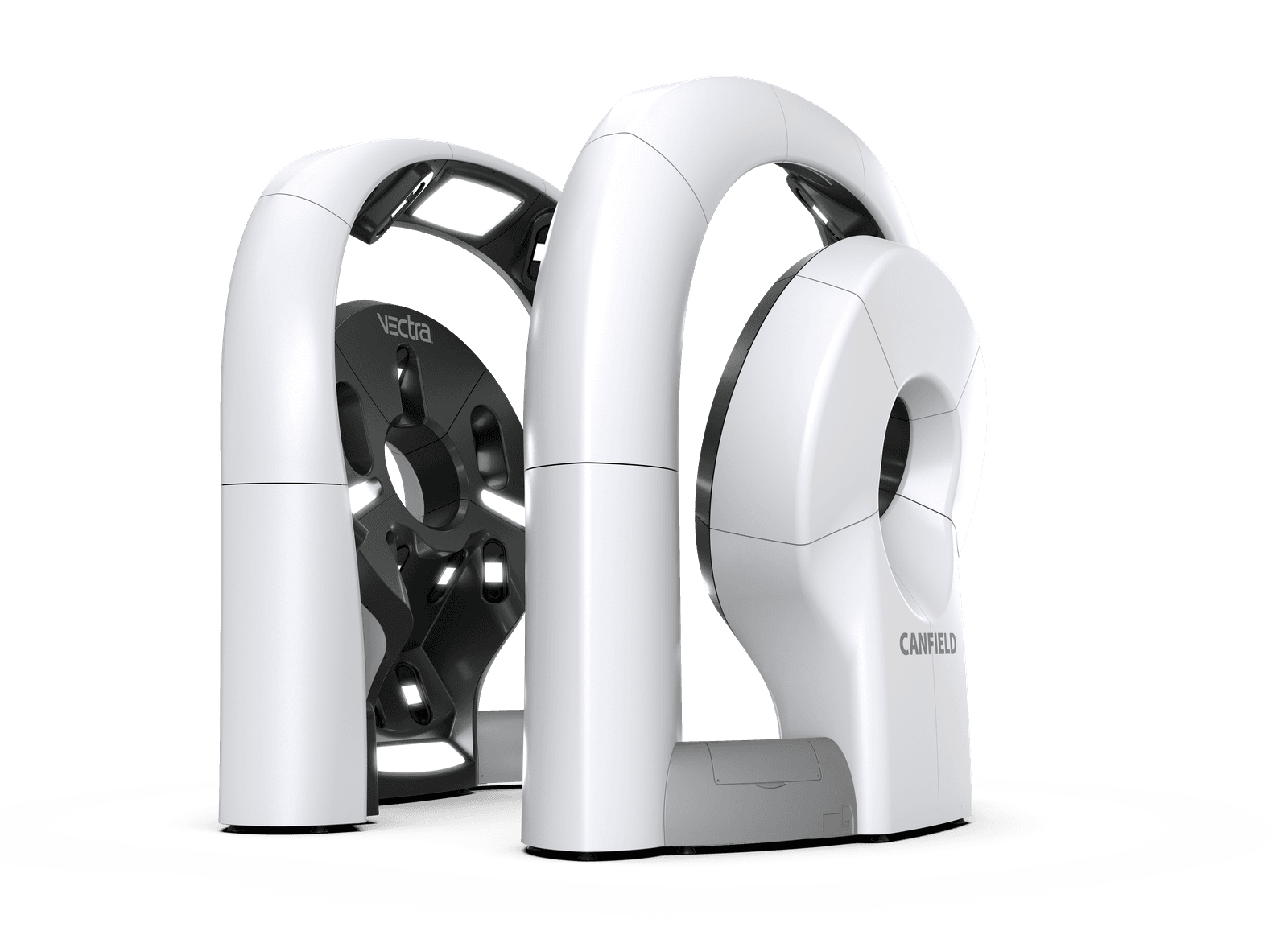
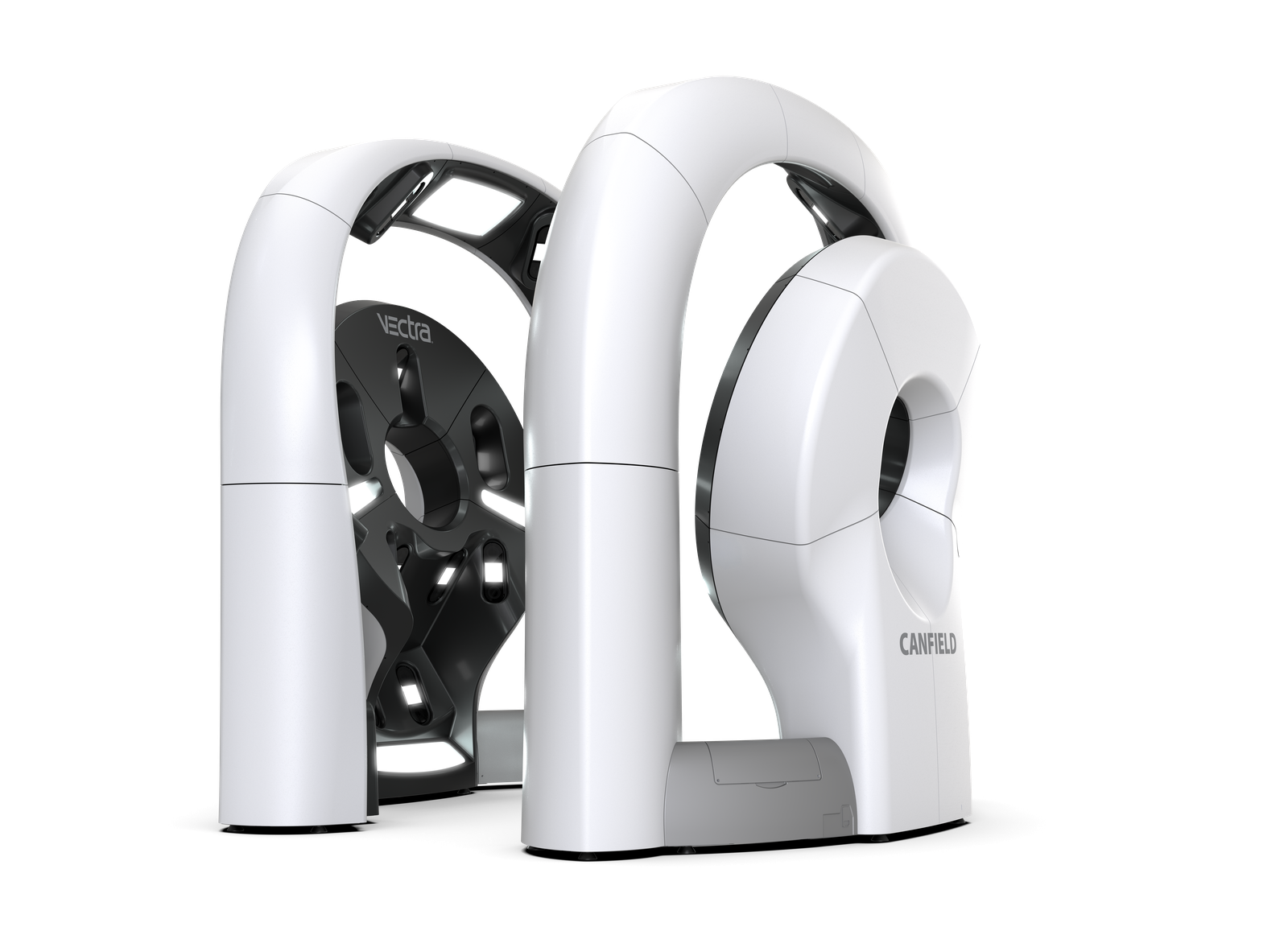
It helps to know that most of the published research on 3D total body photography was done on one system, the Canfield Vectra WB360.3 The high-risk studies from Barcelona, and the studies in Switzerland that compared 2D and 3D imaging, used it as well.27 Naming this matters, because it shapes what the evidence can and cannot tell us. Other tools exist. Flat 2D systems and remote mole-mapping services are still in use, and there is an academic research system from Australia, but the body of 3D evidence sits mostly with one platform.
Where the evidence is strongest
The whole-body map earns its place in the exact spot the older flat method struggled, which is new spots.
In a 2025 study of 1,274 high-risk patients in Barcelona, almost half of the melanomas were found from the 3D map itself, before anyone used a close-up lens.2 An earlier study using the two-step method found that half of its melanomas were caught because of a new spot on the map or a visible change in an old one.8 In a large Australian high-risk clinic, new melanomas were most often first spotted with the help of the photographs.9
For a person with many moles, that is the difference between hunting for one changed spot among hundreds and having the change pointed out on a picture. The melanomas found this way also tend to be thin, which is when melanoma is most treatable.
What it does not do
The honest part matters more than the enthusiasm.
A 2025 randomized study added 3D photography and remote review to usual care and did not find a clear change in two-year results. It caught a similar number of cancers, removed fewer melanomas but more harmless spots, and cost more per person.10 A careful 2025 review put it plainly, that there is not yet enough evidence that 3D photography is reliable on its own.3 The camera also does not see everything. Studies using the 3D system note it cannot capture the scalp, the soles of the feet, or skin under clothing, so a dermatologist's eyes and hands are still needed.11
Photography is the first step. What a dermatologist does with the images afterward, the close-up look at single spots and the software that can help flag a mole for a second look, is a separate step with its own page and its own limits.
Worried about a spot?
SpotDoc offers full-body skin cancer screening in Brownwood Square, The Villages. No referral needed for most plans.
Who it is for
Total body photography is a surveillance tool, so it helps most where catching a new or changing spot early matters most. That usually means people at higher risk of melanoma, such as those with many moles or atypical moles, a personal or family history of melanoma, or a prior melanoma. For someone with only a few typical moles, a regular skin exam and checking your own skin are usually enough, and the map adds little.
When to see a dermatologist
A baseline map does not replace paying attention between visits. See a dermatologist if you notice a spot that is new, that is changing in size, shape, or color, that looks different from your other spots, or that itches or bleeds. If you are unsure whether photography fits your risk, that is a good question to bring to a skin exam.
Frequently asked questions
Is total body photography the same as a skin cancer screening?
No. It is one tool used within a skin exam, not the exam itself. A dermatologist still looks at your skin in person, examines single spots closely, and takes a biopsy when a spot is suspicious. The photographs give them a fixed reference to compare against over time.
Does it use radiation?
No. It is photography. There are no injections and no radiation. You stand in a few poses while cameras capture the skin surface in seconds.
Is 3D better than the older flat photos?
3D builds a whole-body map in one session and makes a new or changed spot easier to find. The research so far shows it helps catch new spots in high-risk patients, but a 2025 randomized study did not show a clear change in two-year results over usual care.10 It is a helpful tool, not a guarantee.
Can the software find melanoma on its own?
Not reliably yet. Software can help flag a spot for a closer look, but reviews of the evidence say it is not dependable on its own, and a dermatologist's judgment is still needed.3
Does it photograph every inch of skin?
Almost, but not all. The scalp, the soles of the feet, and skin under clothing are not fully captured, so those areas still need a hands-on exam.11
Who benefits most?
People at higher risk of melanoma, especially those with many moles or a personal or family history. For someone with few moles and average risk, a routine exam and self-checks usually cover it.2
Questions to ask your dermatologist
- Does my risk of melanoma make a baseline map worth it?
- How often would you repeat the imaging?
- How does the map fit with my regular skin exams and my own checks at home?
- What happens if a spot changes on the map?
Update log
How this guide has changed since it was first published.
- July 15, 2026Guide published.
References
Every statement on this page is backed by the peer-reviewed sources below — each links to the original study. Numbers match the citations in the text and the grids above.
- Hornung A, Steeb T, Wessely A, et al. The value of total body photography for the early detection of melanoma: a systematic review. Int J Environ Res Public Health. 2021;18(4):1726.View source
- Serra-García L, Rezze G, Rivas AC, et al. Clinical outcomes of 3D-total body photography and digital dermoscopy for surveillance of high-risk melanoma patients. A prospective longitudinal observational study. Eur J Cancer. 2025;231:116053.View source
- Baete F, Jakers AL, Delanoye E, Vande Velde N, Voet G. 3D Total Body Photography as a Promising Innovation for Early Skin Cancer Detection: Scoping Review. JMIR Dermatol. 2025;8:e68510.View source
- Salerni G, Carrera C, Lovatto L, et al. Benefits of total body photography and digital dermatoscopy ("two-step method of digital follow-up") in the early diagnosis of melanoma in patients at high risk for melanoma. J Am Acad Dermatol. 2011;67(1):e17–e27.View source
- Salerni G, Carrera C, Lovatto L, et al. Characterization of 1152 lesions excised over 10 years using total-body photography and digital dermatoscopy in the surveillance of patients at high risk for melanoma. J Am Acad Dermatol. 2012;67(5):836–845.View source
- Morris J, Chamberlain A, Guitera P, Mar V. From Analogue to AI: Evolution of Total Body Photography. Australas J Dermatol. 2025;67(2):96–99.View source
- Cerminara SE, Cheng P, Kostner L, et al. Diagnostic performance of augmented intelligence with 2D and 3D total body photography and convolutional neural networks in a high-risk population for melanoma under real-world conditions. Eur J Cancer. 2023;190:112954.View source
- Porcar Saura S, March-Rodríguez A, Pujol RM, Segura Tigell S. Two-Step Digital Follow-up of Patients at High Risk for Melanoma: a Retrospective Analysis of 152 Patients. Actas Dermosifiliogr. 2020;112(3):250–256.View source
- Guitera P, Menzies SW, Coates E, et al. Efficiency of Detecting New Primary Melanoma Among Individuals Treated in a High-risk Clinic for Skin Surveillance. JAMA Dermatol. 2021;157(5):521–530.View source
- Lindsay D, Soyer HP, Janda M, et al. Cost-Effectiveness Analysis of 3D Total-Body Photography for People at High Risk of Melanoma. JAMA Dermatol. 2025;161(5):482–489.View source
- Truong K, Elhindi J, Araujo RR, et al. Asynchronous 3D Photography Is a Reliable Tool for the Assessment of Mycosis Fungoides Clinical Severity. Australas J Dermatol. 2025;66(6):344–349.View source