

For general education, not medical advice. This guide can’t diagnose you or replace care from your own clinician. If you’re worried about a spot or symptom, see a board-certified dermatologist.
Squamous cell carcinoma (SCC) is the second most common skin cancer. It comes from years of ultraviolet light. It often starts in a precancer called an actinic keratosis. Most tumors are found early and cured with surgery. But unlike basal cell carcinoma, some higher-risk tumors can spread, usually first to nearby lymph nodes. That is why risk features and early treatment matter.
Key points
- SCC is the second most common skin cancer; it comes from sun damage and grows faster than basal cell carcinoma.1
- Most are cured with surgery. A higher-risk minority can spread, so the tumor's risk features guide how it is treated and followed.2
- A biopsy confirms it, and people with a weak immune system are higher-risk and need closer skin checks.3
What is squamous cell carcinoma?
SCC is a cancer of the flat (squamous) cells in the outer layer of skin. The main cause is years of ultraviolet light from the sun or tanning beds. It often grows on the most sun-exposed areas: the face, ears, lips, scalp, and backs of the hands. It is common, with hundreds of thousands of cases each year in the United States.1
Most squamous cell carcinomas are cured by removing them. They are taken seriously because some higher-risk tumors can grow deep and spread, usually first to nearby lymph nodes. Spread is uncommon overall. It is more likely with certain tumors, so the risk features below shape the plan.2
Signs and what to look for
Squamous cell carcinoma can show up in several ways. Any spot that is new, growing, tender, or not healing is worth checking. Common signs include:
- A firm red bump or nodule
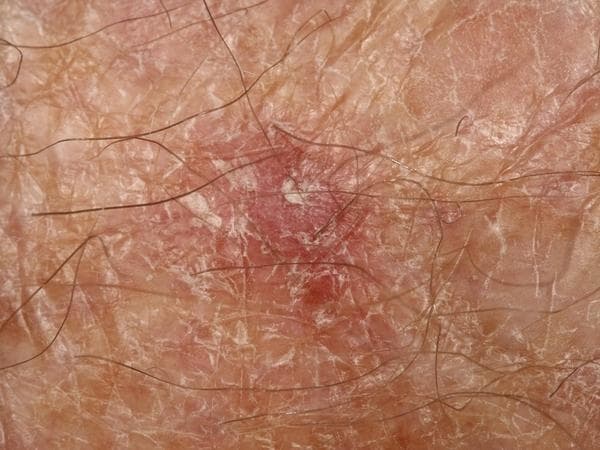
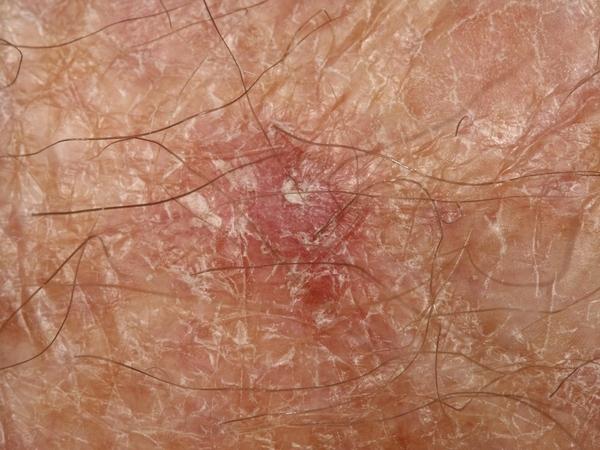
- A rough, scaly, or crusted patch that may bleed
- A sore that does not heal, or heals and comes back
- A wart-like growth or a tender, raised spot, sometimes on the lip or ear
A spot that grows quickly, hurts, or bleeds easily is worth getting looked at sooner.
How it is diagnosed
Diagnosis starts with a skin exam and is confirmed with a biopsy, where a small sample is checked under the microscope. The biopsy shows the type and grade of the tumor, which helps sort it into a risk group.3
Some tumors are higher-risk, which means they are more likely to come back or spread. A tumor is higher-risk if it is large, grows deep, is a higher grade, grows along a nerve, sits on the ear or lip, or grows in someone with a weak immune system.2 Higher-risk tumors may need imaging or a check of the lymph nodes, plus closer follow-up.
How it is treated
Most squamous cell carcinomas are cured with treatment done in the office. The choice depends on the tumor's risk group, size, and location. Here is how the options compare, strongest evidence first.
Surgery is the standard first-line treatment for most localized tumors. A small margin of normal skin clears most tumors, with a wider margin for high-risk ones.4 For high-risk, recurrent, or critical-site tumors, a margin-controlled technique, known as Mohs surgery, checks the entire edge of the removed tissue under the microscope during the procedure; guidelines reserve it for those situations.3
Radiation is an option when surgery is not possible, and it is sometimes added after surgery when a margin cannot be cleared or a tumor has grown along a nerve.5 Scraping-and-cautery or freezing can treat selected small, low-risk tumors, but are not used for high-risk ones.3
The rare tumor that spreads or cannot be cured by surgery and radiation is treated with immunotherapy, given by oncology through a referral.6
Special note for people with a weakened immune system
Organ-transplant recipients and others on long-term immune-suppressing medicine get many more squamous cell carcinomas, and the tumors tend to behave more aggressively.2 If this is you, regular skin checks and prompt treatment of new spots are especially important, and care is usually coordinated with your transplant or specialty team.
Lowering your risk and catching new ones early
Most of the risk comes from ultraviolet light, so sun protection lowers the chance of new skin cancers over time. Treating precancers (actinic keratoses) also helps. For high-risk patients, a daily vitamin (nicotinamide) lowered new skin cancers in a trial, and selected transplant patients may be offered a prescription retinoid.
Cumulative ultraviolet light is the main driver of squamous cell carcinoma, so reducing UV exposure lowers the risk. In a randomized trial, regular sunscreen use lowered the rate of new squamous cell cancers over years of follow-up.
About 30% fewer new squamous cell cancers at one year in a trial of high-risk patients; the benefit only lasts while you take it.
A randomized trial found fewer squamous cell cancers in transplant recipients, but side effects limit use to selected patients and tumors can rebound when it is stopped.
Whole-body prevention, separate from the spot treatments above. “No effect” means good trials found no benefit. Every source is PubMed-verified; not medical advice.
Having one squamous cell carcinoma raises the chance of getting another, so regular skin checks are an important part of care after a diagnosis.
When to see a doctor
See a clinician for any spot that is growing, scaly, tender, bleeding, or not healing, especially on sun-exposed skin like the face, ears, lips, scalp, or hands. If you have had a squamous cell carcinoma before, or you take immune-suppressing medicine, keep up with regular skin checks.
Worried about a spot?
SpotDoc offers full-body skin cancer screening in Brownwood Square, The Villages. No referral needed for most plans.
Frequently asked questions
Is squamous cell carcinoma dangerous? Most are cured when treated early. The concern is the higher-risk minority that can grow deep or spread, usually first to nearby lymph nodes. The tumor's risk features guide how closely it is treated and followed.2
How is it different from basal cell carcinoma? Both come from sun damage, but squamous cell carcinoma grows faster and is more likely to spread, while basal cell carcinoma almost never spreads. Both are usually cured with surgery when caught early.
Will it come back? Most tumors are cured. Cancer left at the edge raises the chance of recurrence, so margins are checked and an involved edge is re-removed.7 Having one SCC also raises the chance of getting another, so ongoing skin checks matter.
Do I need Mohs surgery? Not for every tumor. Mohs is a margin-controlled technique that guidelines reserve for high-risk, recurrent, or critical-site tumors.3 Your clinician can tell you whether your tumor falls into that group.
Why does my immune system matter? People on immune-suppressing medicine, such as transplant recipients, get many more squamous cell carcinomas and more aggressive ones.2 They need closer skin checks and prompt treatment.
Questions to ask your clinician
- What risk group is my tumor, and does it need imaging or a lymph node check?
- Which treatment fits this spot, and will the edges be checked for clear margins?
- Do I need radiation after surgery for any reason?
- How often should I have skin checks now?
- I take immune-suppressing medicine, so how does that change my plan?
Squamous cell carcinoma is one of several skin cancers and precancers. Related guides cover actinic keratosis (its common precancer), basal cell carcinoma, and the treatments above, including surgical excision. A thorough skin cancer screening is the place to start.
Reviewed by Tyler Long, DO. Last reviewed 2026-06-24.
Update log
How this guide has changed since it was first published.
- July 14, 2026Guide published.
References
Every statement on this page is backed by the peer-reviewed sources below — each links to the original study. Numbers match the citations in the text and the grids above.
- Karia PS, Han J, Schmults CD. Cutaneous squamous cell carcinoma: estimated incidence of disease, nodal metastasis, and deaths from disease in the United States, 2012. J Am Acad Dermatol. 2013;68(6):957–966.View source
- Thompson AK, Kelley BF, Prokop LJ, Murad MH, Baum CL. Risk factors for cutaneous squamous cell carcinoma recurrence, metastasis, and disease-specific death: a systematic review and meta-analysis. JAMA Dermatol. 2016;152(4):419–428.View source
- Kim JYS, Kozlow JH, Mittal B, et al. Guidelines of care for the management of cutaneous squamous cell carcinoma. J Am Acad Dermatol. 2018;78(3):560–578.View source
- Brodland DG, Zitelli JA. Surgical margins for excision of primary cutaneous squamous cell carcinoma. J Am Acad Dermatol. 1992;27(2 Pt 1):241–248.View source
- Lansbury L, Bath-Hextall F, Perkins W, Stanton W, Leonardi-Bee J. Interventions for non-metastatic squamous cell carcinoma of the skin: systematic review and pooled analysis of observational studies. BMJ. 2013;347:f6153.View source
- Migden MR, Rischin D, Schmults CD, et al. PD-1 blockade with cemiplimab in advanced cutaneous squamous-cell carcinoma. N Engl J Med. 2018;379(4):341–351.View source
- Spyropoulou GA, Pavlidis L, Trakatelli M, et al. Cutaneous squamous cell carcinoma with incomplete margins demonstrate higher tumour grade on re-excision. J Eur Acad Dermatol Venereol. 2020;34(7):1478–1481.View source
- Migden MR, Khushalani NI, Chang ALS, et al. Cemiplimab in locally advanced cutaneous squamous cell carcinoma: results from an open-label, phase 2, single-arm trial. Lancet Oncol. 2020;21(2):294–305.View source
- Grob JJ, Gonzalez R, Basset-Seguin N, et al. Pembrolizumab monotherapy for recurrent or metastatic cutaneous squamous cell carcinoma: a single-arm phase II trial (KEYNOTE-629). J Clin Oncol. 2020;38(25):2916–2925.View source
- Rischin D, Khushalani NI, Schmults CD, et al. Adjuvant cemiplimab in high-risk cutaneous squamous-cell carcinoma (C-POST). N Engl J Med. 2025;392(21):2092–2104.View source
- Gross ND, Miller DM, Khushalani NI, et al. Neoadjuvant cemiplimab for stage II to IV cutaneous squamous-cell carcinoma. N Engl J Med. 2022;387(17):1557–1568.View source
- Green A, Williams G, Neale R, et al. Daily sunscreen application and betacarotene supplementation in prevention of basal-cell and squamous-cell carcinomas of the skin: a randomised controlled trial. Lancet. 1999;354(9180):723–729.View source
- van der Pols JC, Williams GM, Pandeya N, Logan V, Green AC. Prolonged prevention of squamous cell carcinoma of the skin by regular sunscreen use. Cancer Epidemiol Biomarkers Prev. 2006;15(12):2546–2548.View source
- Chen AC, Martin AJ, Choy B, et al. A Phase 3 Randomized Trial of Nicotinamide for Skin-Cancer Chemoprevention. N Engl J Med. 2015;373(17):1618–1626.View source
- George R, Weightman W, Russ GR, Bannister KM, Mathew TH. Acitretin for chemoprevention of non-melanoma skin cancers in renal transplant recipients. Australas J Dermatol. 2002;43(4):269–273.View source