

For general education, not medical advice. This guide can’t diagnose you or replace care from your own clinician. If you’re worried about a spot or symptom, see a board-certified dermatologist.
Lentigo maligna is a form of melanoma in situ — Stage 0, confined to the top layer of skin — that develops on chronically sun-damaged skin, most often the face of older adults. Like other in-situ melanoma it cannot spread while it stays in situ, and it's highly curable. What sets it apart is a tendency to extend under the surface, beyond the visible edge, which is the single fact that shapes its treatment.1
Key points
- A subtype of melanoma in situ on sun-damaged skin, usually the face of older adults.
- Highly curable, but it spreads subclinically beyond the visible border — so standard wide excision recurs more often (~8–13%) than margin-controlled surgery (~1–2%).12
- Non-surgical options (a topical cream or radiation) exist mainly for people who can't have surgery, and recur more often.34
What is lentigo maligna?
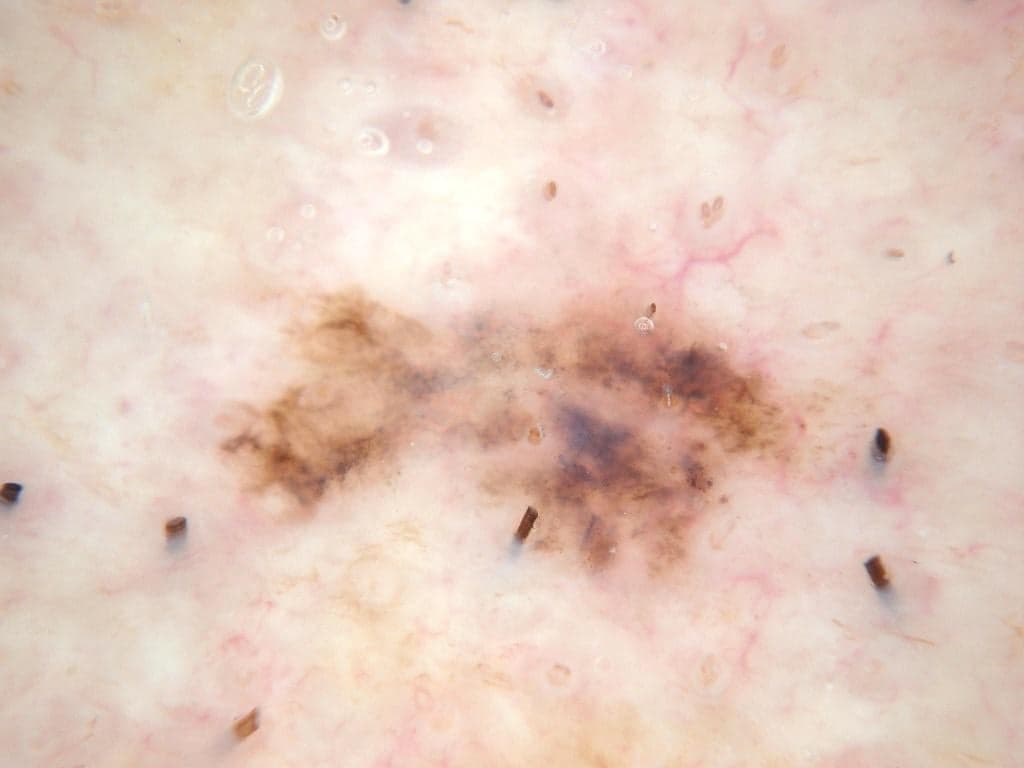
It begins as a slowly enlarging, flat, unevenly colored brown-to-tan patch on sun-exposed skin — easy to mistake for an age spot. Under the microscope it's melanoma in situ; left untreated over years, a portion can progress to invasive melanoma (lentigo maligna melanoma). Because the abnormal cells fan out invisibly past the clinical edge, the visible spot understates the true extent — which is why removal is approached carefully.
Signs to watch for
A tan-to-brown facial patch that is slowly enlarging, has uneven color, or an irregular, blurred border — especially one that looks different from surrounding sun spots. Because it grows slowly and looks benign, it's often caught on a skin exam rather than by the patient.
How it's diagnosed
Diagnosis is by examination, often with dermoscopy, and a skin biopsy to confirm. Because borders are notoriously hard to judge by eye, mapping techniques are sometimes used to define the true extent before treatment.1
What treatment usually looks like
The goal is the same as any in-situ melanoma — remove it completely — but the subclinical spread changes the strategy. Margin-controlled (staged) excision, which checks the edges are clear before closing, has the lowest recurrence and is generally first-line for lentigo maligna, particularly on the face.2 Standard wide excision is an option but recurs more often because it can miss the hidden extension. For people who aren't surgical candidates, a topical immune cream or radiation can be considered, with the trade-off of higher recurrence.
Green means better for you; red means more downside. “Evidence” shows how sure the research is — tap a study count to see the sources. Your dermatologist decides what's right for you.
Your dermatologist weighs the lesion's size and location, your skin and overall health, and cosmetic considerations on the face. As with all in-situ disease, there's no chemotherapy or systemic treatment — the work is local.
Reducing your risk going forward
Lentigo maligna is a marker of significant sun damage, so ongoing protection and surveillance matter: broad-spectrum sun protection, no tanning beds, and regular skin checks. Treating the field of sun damage (for example, actinic keratoses) is often part of the bigger picture.
When to see a doctor
Have any slowly enlarging or color-varied facial patch evaluated — especially if it's changing or stands out from your other sun spots. Early, complete treatment is what keeps it from progressing.
Frequently asked questions
Is lentigo maligna cancer? It is melanoma in situ — the earliest, Stage 0 form of melanoma. It cannot spread while it stays in situ and is highly curable, but it's treated because some lesions can become invasive over time.
Why is surgery done in stages? Lentigo maligna extends invisibly beyond its visible edge, so margin-controlled (staged) excision confirms the borders are truly clear before the wound is closed — which lowers the chance it comes back.2
Can it be treated without surgery? A topical cream (imiquimod, off-label) or radiation can be used mainly when surgery isn't feasible. Both recur more often than margin-controlled surgery, so they're generally second-line.34
Reviewed by Tyler Long, DO. Last updated June 2026.
References
-
Friedman EB, Scolyer RA, Williams GJ, Thompson JF. Melanoma in situ: a critical review and re-evaluation of current excision margin recommendations. Adv Ther. 2021;38(7):3506–3530. doi:10.1007/s12325-021-01783-x ↩ ↩2 ↩3
-
Bittar PG, Bittar JM, Etzkorn JR, et al. Systematic review and meta-analysis of local recurrence rates of head and neck cutaneous melanomas after wide local excision, Mohs micrographic surgery, or staged excision. J Am Acad Dermatol. 2021;85(3):681–692. doi:10.1016/j.jaad.2021.04.090 ↩ ↩2 ↩3
-
Read T, Noonan C, David M, et al. A systematic review of non-surgical treatments for lentigo maligna. J Eur Acad Dermatol Venereol. 2015;30(5):748–753. doi:10.1111/jdv.13252 ↩ ↩2
-
Fogarty GB, Hong A, Scolyer RA, et al. Radiotherapy for lentigo maligna: a literature review and recommendations for treatment. Br J Dermatol. 2014;170(1):52–58. doi:10.1111/bjd.12611 ↩ ↩2