

For general education, not medical advice. This guide can’t diagnose you or replace care from your own clinician. If you’re worried about a spot or symptom, see a board-certified dermatologist.
An actinic keratosis (also called a solar keratosis) is a rough, scaly spot that grows on skin after years of sun. It is the most common precancer. It is not cancer yet, but it is the most direct warning sign that sun damage has reached a level that can lead to squamous cell carcinoma. The good news: these spots are easy to find and very treatable, and treating them is one of the simplest ways to prevent skin cancer.
Key points
- An actinic keratosis is a precancer. It is a rough, scaly spot from years of sun that can slowly turn into squamous cell carcinoma.1
- We treat them because no one can tell which single spot will turn into cancer, and clearing the sun-damaged area is a proven way to lower that risk.2
- Most are cleared in the office or with a skin cream, and ongoing sun protection plus regular skin checks keep new ones in check.3
If you have been told you have "a lot of sun damage" or several rough spots, this guide explains what that means and the choices for treating it.
What is an actinic keratosis?
Years of ultraviolet (UV) light from the sun damage the DNA in the top layer of skin cells. Over time, some of those cells start to grow in an abnormal way and form a rough, scaly patch. That patch is an actinic keratosis.
It sits on the line between healthy skin and skin cancer. Left alone, a small share of these spots can slowly turn into squamous cell carcinoma, a common skin cancer. Most never do, and some even fade on their own. The problem is that there is no reliable way to tell which spot will turn, which is why doctors treat them rather than wait.1
When many spots cluster in one sun-exposed area, doctors call it "field cancerization." It means the whole area, not just the spots you can see, carries extra risk.4
Signs to watch for
Actinic keratoses show up on the places that get the most sun: the face, the scalp (especially where hair is thin), the ears, the lips, the neck, the backs of the hands, and the forearms.
Common signs include:
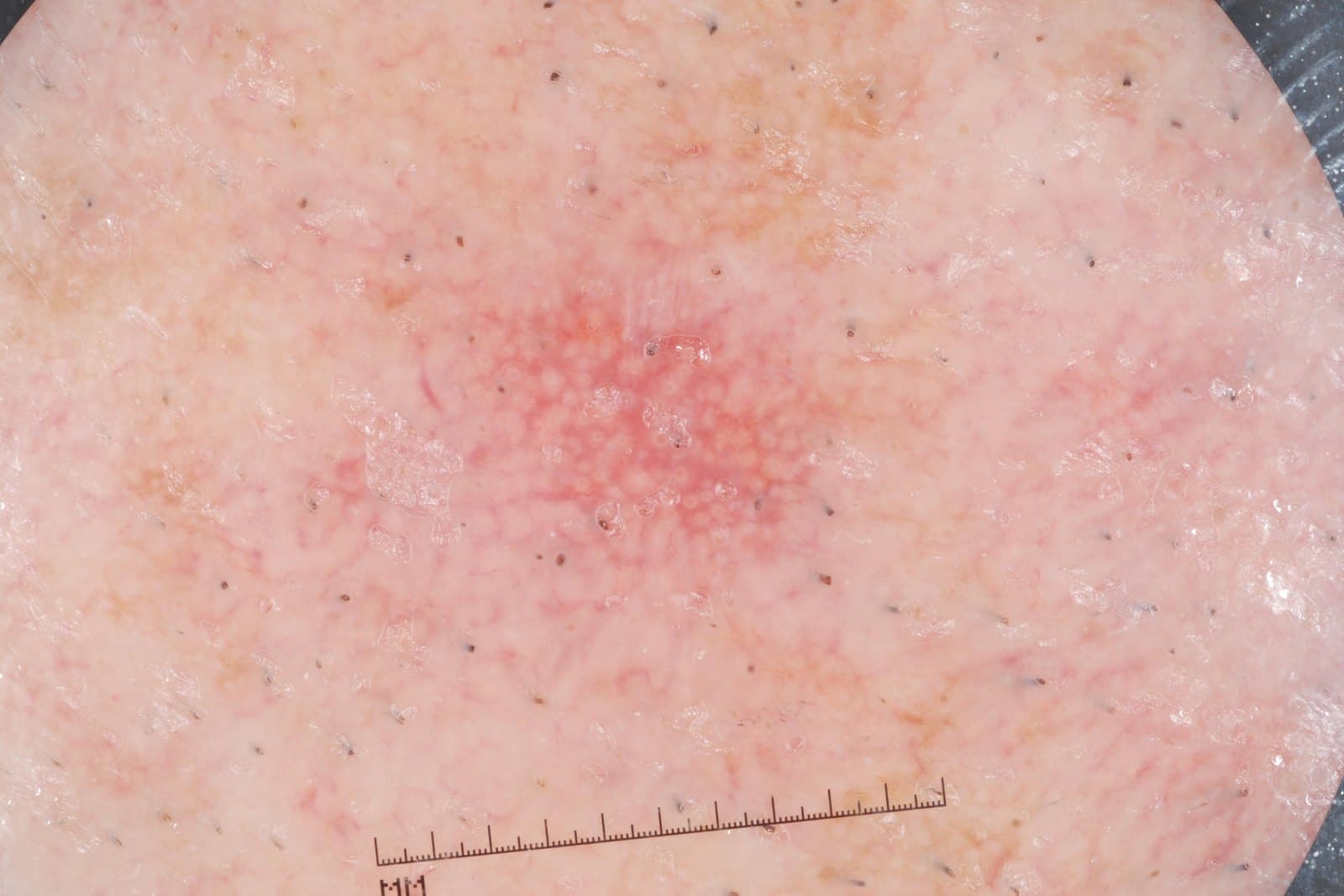
- A rough, dry, or scaly patch, often easier to feel than to see, like fine sandpaper.
- A flat or slightly raised spot that may be pink, red, tan, or skin-colored.
- Itching, burning, or tenderness in the area.
- A thick or wart-like bump in some cases.
- On the lip, dryness, scaling, or a pale color (this is called actinic cheilitis).
A spot that grows fast, thickens, bleeds, or becomes tender may have turned into a skin cancer and should be checked promptly.
How it's diagnosed
Most actinic keratoses are diagnosed by sight and touch. A dermatologist can usually recognize them on exam, often with the help of a dermatoscope (a special magnifier).
If a spot looks like it may have turned into a cancer (thick, raised, bleeding, or fast-growing), a small skin biopsy is taken. A biopsy is the only way to know for sure whether a spot is still a precancer or has become a squamous cell carcinoma.1
What treatment usually looks like
Because no one can predict which spot will turn into cancer, the goal is to clear the spots you can see and calm the sun-damaged area around them. There are two broad approaches, and they are often combined:
- Spot (lesion-directed) treatment removes one spot at a time. Freezing with liquid nitrogen is the most common example. It is quick and works well for a few lesions.
- Field treatment treats a whole area at once with a cream or a light treatment. This makes sense when there are many spots or widespread sun damage, because it also reaches the early spots that are not yet visible.
Which approach fits you depends on how many spots you have, where they are, how thick they are, and how much time and skin-soreness you can manage. The grid above compares the main options. There is no single "best" choice for everyone. For a few visible spots, freezing is fast and simple. For widespread sun damage, a field cream or photodynamic therapy treats the whole area. The right plan is a shared decision with your dermatologist, and many people use more than one method over time.
Field treatment vs. spot treatment
It helps to think about it this way. Freezing handles the spots you can point to. Field treatments (creams or light) handle the spots you can see and the early ones you cannot, across a whole sun-damaged area like the scalp or the backs of the hands.3
Field creams ask more of you up front: the skin gets red, sore, and flaky for a couple of weeks while the treatment does its job. That reaction is the treatment working, and it settles as the skin heals. The trade is that one course can clear a large area and keep it clearer for a year or more.5
Other options patients ask about
When people read about actinic keratoses online, the same home remedies come up again and again. Here is what the research actually shows.
Black salve (a corrosive or "escharotic" paste). Avoid this one. Black salve is a caustic paste that burns away skin. It does not single out cancer; it destroys healthy and damaged skin alike and often leaves scars.6 Worse, it can hide a skin cancer instead of curing it. In a five-year review of people who used black salve, a cancer was still present in about a third of the treated spots after the salve had healed over them.7 Doctors have also found basal cell and squamous cell cancers left behind under the scar.8 There is no trial showing it works.9
Apple cider vinegar and other "natural" acids. Avoid using these to burn off a spot. Apple cider vinegar is acidic enough to cause a chemical burn, and doctors have reported burns in both adults and teenagers who followed online recipes to remove spots this way.1011 It does not treat the sun damage underneath, and it carries the same risk of hiding a cancer.
Cutting, scraping, or picking a spot off yourself. Don't. You can scar the skin, cause an infection, and remove the very tissue a doctor needs to check under the microscope.
Over-the-counter freeze-off kits. The freeze sprays sold for warts are not designed or tested for actinic keratoses. Using one on a sun-damaged spot can injure healthy skin without treating the area around it. In-office freezing is colder, more controlled, and aimed at the right target.
Drugstore retinol or acid creams. These can smooth skin, but there is no good evidence they clear actinic keratoses, and they are not a substitute for the prescription field creams or in-office treatments above.
The safe move is simple: a rough or scaly spot that will not go away should be looked at, not burned or cut off at home. An actinic keratosis can already be an early squamous cell carcinoma, and only a trained eye, with a small biopsy when needed, can tell the difference.
Why treating actinic keratoses matters
Any single actinic keratosis has only a small chance of turning into cancer in a given year.2 But two facts make treatment worthwhile. First, when squamous cell carcinomas are studied, a large share started as a spot that had been an actinic keratosis.12 Second, people with these spots usually have many of them, and the risk adds up across the whole area over time. Treating the field lowers that risk, and a single course of 5-FU cream has been shown to cut squamous cell cancers on the face and ears for the first year after use.5
This matters even more for people whose immune system is low, such as organ-transplant recipients. In that group, actinic keratoses turn into skin cancer far more often, so earlier and more active treatment is the rule.13
Reducing your risk going forward
New spots come from new sun exposure, so prevention is mostly about protecting your skin:
- Use broad-spectrum SPF 30+ sunscreen every day, and reapply when you are outside. Daily sunscreen has been shown in trials to lower the number of new actinic keratoses, and over the long term to lower squamous cell cancers.14
- Cover up with a wide-brimmed hat, long sleeves, and UV-blocking sunglasses.
- Avoid the midday sun (about 10 a.m. to 4 p.m.) and skip tanning beds entirely.
- Keep regular skin checks. They catch new spots early, when they are easiest to treat. People with a lot of moles or sun damage may benefit from total body photography to track changes over time.
For people at high risk who keep getting skin cancers, a daily vitamin called nicotinamide (vitamin B3) has lowered new precancers and skin cancers in studies. The benefit only lasts while you take it, and it has not helped transplant patients in trials.15 Ask your dermatologist whether it fits your situation.
How the prevention options compare:
Actinic keratoses come from cumulative ultraviolet exposure, so reducing UV lowers the risk. Daily sunscreen led to fewer new actinic keratoses, and over years of follow-up, fewer squamous cell cancers.
About 23% fewer new skin cancers and 13% fewer AKs at one year; the benefit only lasts while you take it.
Randomized trials in transplant recipients, and a pooled meta-analysis, found no reduction in skin cancers.
Randomized trials show fewer squamous cell cancers in this high-risk group, but side effects limit use to selected patients.
Multiple randomized trials found no reduction in actinic keratoses or skin cancer.
Whole-body prevention, separate from the spot treatments above. “No effect” means good trials found no benefit. Every source is PubMed-verified; not medical advice.
When to see a doctor
Have any rough, scaly, or persistent spot on sun-exposed skin checked, especially if it itches, bleeds, thickens, or has been there more than a month. Actinic keratoses are common and very treatable, and catching them early is one of the best ways to stay ahead of skin cancer.
If you have had actinic keratoses before, plan on a skin exam at least once a year, and more often if you are immunosuppressed or have had many spots.
Worried about a spot?
SpotDoc offers full-body skin cancer screening in Brownwood Square, The Villages. No referral needed for most plans.
Frequently asked questions
Is an actinic keratosis skin cancer? No. It is a precancer. It is not cancer, but it can slowly turn into squamous cell carcinoma over time, which is why doctors treat it rather than wait.
Will my actinic keratosis turn into cancer? Probably not. Any single spot has only a small chance each year. But there is no way to know which one will, and many spots together add up to real risk, so treating them is the safe choice.
What is the best treatment? There is no single best option. Freezing is quick for a few spots. Creams and light treatments clear a whole sun-damaged area. In the one head-to-head trial, 5-fluorouracil cream cleared the most spots of the field creams, but the right plan depends on how many spots you have and what you can manage. It is a shared decision with your dermatologist.
Do the creams really make my skin look worse before it gets better? Yes, and that is expected. Field creams cause redness, soreness, and flaking for a couple of weeks while they clear the damaged cells. The skin then heals, often looking and feeling better than before.
How many treatments will I need? It varies. A few spots may need only one freezing visit. Widespread sun damage often needs a full course of a cream, sometimes a second light-treatment session, and many people return for touch-ups over the years as new spots appear.
Can actinic keratoses come back? New spots are common because the underlying sun damage does not go away. That is why ongoing sun protection and regular skin checks matter as much as the treatment itself.
Are actinic keratoses more serious if I am a transplant patient? Yes. If your immune system is suppressed, these spots turn into skin cancer far more often, so they are watched and treated more aggressively. Tell your dermatologist about any transplant or immune condition.
Can I treat an actinic keratosis at home with apple cider vinegar or black salve? No. These burn the skin without treating the sun damage underneath, can leave scars, and can hide a skin cancer instead of removing it. A spot that will not go away should be checked by a dermatologist, not burned or cut off at home.
Questions to ask your dermatologist
- Do I have a few spots to freeze, or widespread sun damage that needs field treatment?
- Which treatment fits my skin, my schedule, and how much soreness I can manage?
- How will I know the treatment worked, and when should I come back?
- What should make me call the office sooner?
- Given my history, how often should I have my skin checked?
Reviewed by Tyler Long, DO. Last reviewed June 2026.
Update log
How this guide has changed since it was first published.
- July 28, 2026Guide published.
References
Every statement on this page is backed by the peer-reviewed sources below — each links to the original study. Numbers match the citations in the text and the grids above.
- Eisen DB, Asgari MM, Bennett DD, et al. Guidelines of care for the management of actinic keratosis. J Am Acad Dermatol. 2021;85(4):e209–e233.View source
- Werner RN, Sammain A, Erdmann R, et al. The natural history of actinic keratosis: a systematic review. Br J Dermatol. 2013;169(3):502–518.View source
- Gupta AK, Paquet M, Villanueva E, Brintnell W. Interventions for actinic keratoses. Cochrane Database Syst Rev. 2012;12:CD004415.View source
- Yeung H, Baranowski MLH, Swerlick RA, et al. Use and cost of actinic keratosis destruction in the Medicare Part B Fee-for-Service population, 2007 to 2015. JAMA Dermatol. 2018;154(11):1281–1285.View source
- Weinstock MA, Thwin SS, Siegel JA, et al. Chemoprevention of Basal and Squamous Cell Carcinoma With a Single Course of Fluorouracil, 5%, Cream: A Randomized Clinical Trial. JAMA Dermatol. 2018;154(2):167–174.View source
- Lim A. Black salve treatment of skin cancer: a review. J Dermatolog Treat. 2018;29(4):388–392.View source
- Croaker A, Liu L, Myers SP. Persisting cancer in black salve treated skin lesions: results of a large 5-year retrospective analysis of Australian histopathology specimens. Integr Cancer Ther. 2023;22:15347354221151145.View source
- Leecy TN, Beer TW, Harvey NT, et al. Histopathological features associated with application of black salve to cutaneous lesions: a series of 16 cases and review of the literature. Pathology. 2013;45(7):670–674.View source
- Eastman KL, McFarland LV, Raugi GJ. A review of topical corrosive black salve. J Altern Complement Med. 2013;20(4):284–289.View source
- Feldstein S, Afshar M, Krakowski AC. Chemical burn from vinegar following an internet-based protocol for self-removal of nevi. J Clin Aesthet Dermatol. 2015;8(6):50.View source
- Bunick CG, Lott JP, Warren CB, Galan A, Bolognia J, King BA. Chemical burn from topical apple cider vinegar. J Am Acad Dermatol. 2012;67(4):e143–e144.View source
- Criscione VD, Weinstock MA, Naylor MF, et al. Actinic keratoses: natural history and risk of malignant transformation in the Veterans Affairs Topical Tretinoin Chemoprevention Trial. Cancer. 2009;115(11):2523–2530.View source
- Chen K, Craig JC, Shumack S. Oral retinoids for the prevention of skin cancers in solid organ transplant recipients: a systematic review of randomized controlled trials. Br J Dermatol. 2005;152(3):518–523.View source
- Thompson SC, Jolley D, Marks R. Reduction of solar keratoses by regular sunscreen use. N Engl J Med. 1993;329(16):1147–1151.View source
- Chen AC, Martin AJ, Choy B, et al. A Phase 3 Randomized Trial of Nicotinamide for Skin-Cancer Chemoprevention. N Engl J Med. 2015;373(17):1618–1626.View source
- Jansen MHE, Kessels JPHM, Nelemans PJ, et al. Randomized Trial of Four Treatment Approaches for Actinic Keratosis. N Engl J Med. 2019;380(10):935–946.View source
- Pomerantz H, Hogan D, Eilers D, et al. Long-term Efficacy of Topical Fluorouracil Cream, 5%, for Treating Actinic Keratosis: A Randomized Clinical Trial. JAMA Dermatol. 2015;151(9):952–960.View source
- Lebwohl M, Dinehart S, Whiting D, et al. Imiquimod 5% cream for the treatment of actinic keratosis: results from two phase III, randomized, double-blind, parallel group, vehicle-controlled trials. J Am Acad Dermatol. 2004;50(5):714–721.View source
- Korman N, Moy R, Ling M, et al. Dosing with 5% imiquimod cream 3 times per week for the treatment of actinic keratosis: results of two phase 3, randomized, double-blind, parallel-group, vehicle-controlled trials. Arch Dermatol. 2005;141(4):467–473.View source
- Thai KE, Fergin P, Freeman M, et al. A prospective study of the use of cryosurgery for the treatment of actinic keratoses. Int J Dermatol. 2004;43(9):687–692.View source
- Piacquadio DJ, Chen DM, Farber HF, et al. Photodynamic therapy with aminolevulinic acid topical solution and visible blue light in the treatment of multiple actinic keratoses of the face and scalp: investigator-blinded, phase 3, multicenter trials. Arch Dermatol. 2004;140(1):41–46.View source
- Dirschka T, Radny P, Dominicus R, et al. Photodynamic therapy with BF-200 ALA for the treatment of actinic keratosis: results of a multicentre, randomized, observer-blind phase III study in comparison with a registered methyl-5-aminolaevulinate cream and placebo. Br J Dermatol. 2012;166(1):137–146.View source
- Mei X, Wang L, Zhang R, Zhong S. Daylight versus conventional photodynamic therapy for the treatment of actinic keratosis: A meta-analysis of randomized controlled trials. Photodiagnosis Photodyn Ther. 2019;25:23–28.View source
- Blauvelt A, Kempers S, Lain E, et al. Phase 3 Trials of Tirbanibulin Ointment for Actinic Keratosis. N Engl J Med. 2021;384(6):512–520.View source
- Wolf JE Jr, Taylor JR, Tschen E, Kang S. Topical 3.0% diclofenac in 2.5% hyaluronan gel in the treatment of actinic keratoses. Int J Dermatol. 2001;40(11):709–713.View source
- Worley B, Harikumar V, Reynolds K, et al. Treatment of actinic keratosis: a systematic review. Arch Dermatol Res. 2023;315(5):1099–1108.View source
- Cunningham TJ, Tabacchi M, Eliane JP, et al. Randomized trial of calcipotriol combined with 5-fluorouracil for skin cancer precursor immunotherapy. J Clin Invest. 2017;127(1):106–116.View source
- Rosenberg AR, Tabacchi M, Ngo KH, et al. Skin cancer precursor immunotherapy for squamous cell carcinoma prevention. JCI Insight. 2019;4(6):e125476.View source
- Ko DY, Jeon SY, Kim KH, Song KH. Fractional erbium:YAG laser-assisted photodynamic therapy for facial actinic keratoses: a randomized, comparative, prospective study. J Eur Acad Dermatol Venereol. 2014;28(11):1529–1539.View source
- Steeb T, Wessely A, Petzold A, et al. Evaluation of Long-term Clearance Rates of Interventions for Actinic Keratosis: A Systematic Review and Network Meta-analysis. JAMA Dermatol. 2021;157(9):1066–1077.View source
- Darlington S, Williams G, Neale R, Frost C, Green A. A randomized controlled trial to assess sunscreen application and beta carotene supplementation in the prevention of solar keratoses. Arch Dermatol. 2003;139(4):451–455.View source
- Green A, Williams G, Neale R, et al. Daily sunscreen application and betacarotene supplementation in prevention of basal-cell and squamous-cell carcinomas of the skin: a randomised controlled trial. Lancet. 1999;354(9180):723–729.View source
- van der Pols JC, Williams GM, Pandeya N, Logan V, Green AC. Prolonged prevention of squamous cell carcinoma of the skin by regular sunscreen use. Cancer Epidemiol Biomarkers Prev. 2006;15(12):2546–2548.View source
- Ulrich C, Jürgensen JS, Degen A, et al. Prevention of non-melanoma skin cancer in organ transplant patients by regular use of a sunscreen: a 24 months, prospective, case-control study. Br J Dermatol. 2009;161(Suppl 3):78–84.View source
- Surjana D, Halliday GM, Martin AJ, Moloney FJ, Damian DL. Oral nicotinamide reduces actinic keratoses in phase II double-blinded randomized controlled trials. J Invest Dermatol. 2012;132(5):1497–1500.View source
- Mainville L, Smilga AS, Fortin PR. Effect of Nicotinamide in Skin Cancer and Actinic Keratoses Chemoprophylaxis, and Adverse Effects Related to Nicotinamide: A Systematic Review and Meta-Analysis. J Cutan Med Surg. 2022;26(3):297–308.View source
- Allen NC, Martin AJ, Snaidr VA, et al. Nicotinamide for Skin-Cancer Chemoprevention in Transplant Recipients. N Engl J Med. 2023;388(9):804–812.View source
- Zhang H, George-Washburn EA, Hashemi KB, et al. Oral Nicotinamide for Actinic Keratosis Prevention in Kidney Transplant Recipients: A Pilot Double-Blind, Randomized, Placebo-Controlled Trial. Transplant Proc. 2023;55(9):2079–2084.View source
- Tosti G, Pepe F, Gnagnarella P, et al. The Role of Nicotinamide as Chemo-Preventive Agent in NMSCs: A Systematic Review and Meta-Analysis. Nutrients. 2023;16(1):100.View source
- Bavinck JN, Tieben LM, Van der Woude FJ, et al. Prevention of skin cancer and reduction of keratotic skin lesions during acitretin therapy in renal transplant recipients: a double-blind, placebo-controlled study. J Clin Oncol. 1995;13(8):1933–1938.View source
- George R, Weightman W, Russ GR, Bannister KM, Mathew TH. Acitretin for chemoprevention of non-melanoma skin cancers in renal transplant recipients. Australas J Dermatol. 2002;43(4):269–273.View source
- Bath-Hextall F, Leonardi-Bee J, Somchand N, et al. Interventions for preventing non-melanoma skin cancers in high-risk groups. Cochrane Database Syst Rev. 2007;(4):CD005414.View source
- Greenberg ER, Baron JA, Stukel TA, et al. A clinical trial of beta carotene to prevent basal-cell and squamous-cell cancers of the skin. N Engl J Med. 1990;323(12):789–795.View source