

For general education, not medical advice. This guide can’t diagnose you or replace care from your own clinician. If you’re worried about a spot or symptom, see a board-certified dermatologist.
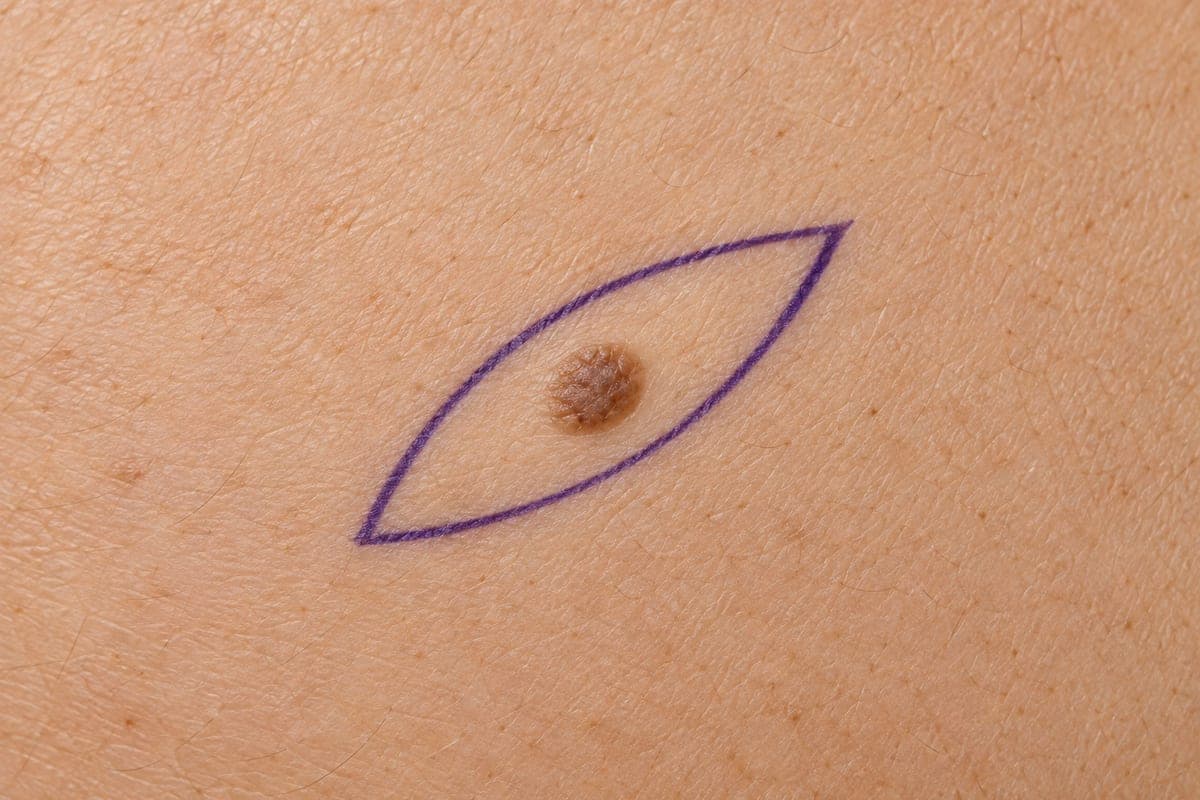
Surgical excision is the cut-it-out treatment for skin cancer. The surgeon numbs the area, removes the growth along with a rim of normal-looking skin around it, and closes the wound. That removed skin goes to a lab, where a pathologist confirms what it is and checks that the edges are clear. It is the standard treatment for basal cell carcinoma, squamous cell carcinoma, and melanoma.
Key points
- Surgical excision removes the cancer and sends it to a lab, so it treats the growth and confirms the diagnosis at the same time.1
- It is the standard, curative treatment for the common skin cancers, including melanoma.2
- The rim of normal skin, called the margin, is matched to the cancer; trials show a margin matched to the tumor is as safe as a wider one.3
What is surgical excision?
Surgical excision means cutting the cancer out. The surgeon removes the visible growth plus a border of normal skin, because a skin cancer can reach a little past what the eye can see. That border is called the margin. Removing it gives the cancer the best chance of being gone for good.4
The other thing excision does is give the lab a sample. A pathologist reads the tissue, confirms the type of cancer, and checks whether the cancer reaches the edge of what was removed. Treatments that burn or freeze a growth cannot do this, because nothing is left to examine. That is a big reason surgery is the standard for cancers that need a sure diagnosis.5
How it is done
Most excisions are done in the office under local numbing. You are awake, and the area is numb. The surgeon removes the growth and a margin of normal skin, usually in an oval so the wound closes in a neat line, then places stitches. The sample is sent to the lab. Larger or trickier spots may need a flap or a skin graft to close, and a few need a hospital setting. Your clinician will explain what your spot needs before the day of surgery.
What surgical excision treats
Surgery is used across the common skin cancers. Here is what it treats and how well the research shows it works, strongest first.
Grouped by how strongly this treatment is indicated. Up bars show how well it works for each condition; green means better. Tap a study count to see the sources. Your dermatologist decides what's right for you.
How well it works
The table above summarizes the evidence by condition. The detail below adds the key numbers.
For melanoma, surgery is the main treatment. The margin is matched to how deep the melanoma goes. This is one of the most studied questions in skin surgery. In thin melanoma, a 1 cm margin gave the same survival as a 3 cm or wider one.6 But the margin can be too narrow. In melanoma 2 mm or thicker, a 1 cm margin led to more cancer returning nearby than a 3 cm margin, and over time more melanoma deaths. So 1 cm is not enough for thicker tumors.78 Going wider than needed does not help either. For thicker melanoma a 2 cm margin matched a 4 cm one, and for thinner melanoma 2 cm matched 5 cm.3910 The trials point to a margin matched to the tumor: wide enough to be safe, not wider.11
For the earliest, surface-only melanoma (melanoma in situ, including the lentigo maligna type on the face), the catch is that it can spread sideways under normal-looking skin. The usual small margin often does not clear it, so a wider or staged removal may be needed.12
For basal cell carcinoma, surgery is highly curative. A 4 mm rim of normal skin cleared more than 95% of small, well-defined tumors in a margin study.4 In a head-to-head trial of low-risk BCC, surgery cleared 98% of people at 3 years, more than a prescription cream at 84%.13 For squamous cell carcinoma, a 4 mm margin cleared most tumors, with a wider margin for higher-risk ones.14 When cancer is left at the edge, it comes back more often. That is why clear margins matter, and why an involved edge is usually re-removed.1516
For high-risk or returning cancers on the face, the edges matter even more, so a margin-controlled removal is used. This includes Mohs surgery, where the surgeon checks the whole edge under the microscope during the procedure. In a 10-year trial of high-risk facial BCC, standard excision had more recurrences than this approach, a difference that was clear for returning tumors.17 Many recurrences appeared after 5 years, so long follow-up matters.
Scars and recovery
Every excision leaves a scar, and a wider margin means a bigger one. The honest trade-off is that more skin removed can mean more repair work and a longer mark. In a melanoma trial, people treated with the wider margin had more early discomfort and a bit more trouble in the first month, but that settled by 6 months; they did tend to keep a poorer view of their scar.18 A more recent trial found a wider margin needed more reconstruction and had more wound problems, with no difference in quality of life at a year.19 The margin is chosen to clear the cancer first; the scar is the cost of doing that well.
Other options patients ask about
People often look for a way to avoid surgery. Here is what the evidence shows.
- A cream instead of surgery is reasonable only for some low-risk, surface-level basal cell carcinomas, and surgery still cures more. In the head-to-head trial, surgery cleared 98% of people vs 84% with the cream.13 A cream is not a substitute for surgery for deeper BCC, for squamous cell carcinoma, or for melanoma.
- Black salve and similar corrosive pastes are harmful. They are sold online as a skin cancer cure, but the claims are not backed by evidence. In one series they left cancer behind in the skin and let it hide under a scar, with poor cosmetic results.20
- Cutting or scraping a growth off at home is unsafe. You get no lab diagnosis, the cancer may be left behind, and the wound can get infected. Even edges missed by a trained surgeon raise the chance the cancer returns, and a home attempt has no margin check at all.15
Why getting the spot checked first matters
The whole value of surgical excision is that it removes the cancer with a measured margin and gives a sample the lab can read. Anything that destroys a growth without a diagnosis, like a corrosive paste or a home removal, throws away both of those. A melanoma or a deeper squamous cell cancer can be left behind, hidden under a scar.20 A spot that is new, changing, bleeding, or different from your others should be examined, and biopsied if needed, then removed properly if it is a cancer. It should not be burned or cut off blind.
When to see a doctor
See a clinician for any spot that is new, changing, bleeding, or not healing, so it can be checked before anything is done to it. After an excision, call your clinician if the wound becomes very painful, oozing, or looks infected, if the stitches open, or if a treated area later forms a new bump or firm spot, since some cancers can return years later.17
Worried about a spot?
SpotDoc offers full-body skin cancer screening in Brownwood Square, The Villages. No referral needed for most plans.
Frequently asked questions
What is a margin? The margin is the rim of normal-looking skin taken around the cancer. A skin cancer can reach a little past its visible edge, so removing a margin gives the best chance of clearing it.4 The width is matched to the type and depth of the cancer.2
Is a bigger margin always better? No. For melanoma, trials show a margin matched to the tumor is as safe as a wider one, and a wider margin mainly means a bigger scar and more repair work, not better survival.311 The goal is a margin wide enough to clear the cancer, not wider.
Will I need stitches, and how big is the scar? Most excisions are closed with stitches and leave a thin line. A wider margin or a tricky spot can mean a larger repair, sometimes a flap or graft. Early discomfort from a wider removal tends to settle within months.18
What if the lab finds cancer at the edge? That means some cancer may have been left behind, which raises the chance it returns, so the area is usually re-removed.1516 This is one reason the lab check is so useful.
Can I treat it with a cream instead? Only for some low-risk, surface-level basal cell carcinomas, and surgery still cures more (98% vs 84% in a head-to-head trial).13 A cream is not an option for melanoma or for deeper cancers.
Are at-home removal kits or black salve safe? No. Corrosive pastes are harmful and can leave a cancer hidden under a scar, and home removal gives no diagnosis and no margin check.20 Get the spot examined and treated properly.
Questions to ask your clinician
- Has this spot been examined, and does it need a biopsy before it is removed?
- What margin do you plan to take, and how will the wound be closed?
- Will the sample be checked for clear edges, and how will I hear the result?
- What should I watch for as the wound heals, and when do the stitches come out?
- How will we follow this area over time in case anything returns?
Surgical excision is one of several ways to treat skin cancer. Others, like cryotherapy, creams such as 5-fluorouracil and imiquimod, and photodynamic therapy, fit specific situations. Which one is right depends on the type of cancer, where it is, and your own health. A thorough skin cancer screening is the place to start.
Reviewed by Tyler Long, DO. Last reviewed 2026-06-24.
Update log
How this guide has changed since it was first published.
- September 15, 2026Guide published.
References
Every statement on this page is backed by the peer-reviewed sources below — each links to the original study. Numbers match the citations in the text and the grids above.
- Kim JYS, Kozlow JH, Mittal B, et al. Guidelines of care for the management of basal cell carcinoma. J Am Acad Dermatol. 2018;78(3):540–559.View source
- Swetter SM, Tsao H, Bichakjian CK, et al. Guidelines of care for the management of primary cutaneous melanoma. J Am Acad Dermatol. 2019;80(1):208–250.View source
- Gillgren P, Drzewiecki KT, Niin M, et al. 2-cm versus 4-cm surgical excision margins for primary cutaneous melanoma thicker than 2 mm: a randomised, multicentre trial. Lancet. 2011;378(9803):1635–1642.View source
- Wolf DJ, Zitelli JA. Surgical margins for basal cell carcinoma. Arch Dermatol. 1987;123(3):340–344.View source
- Kim JYS, Kozlow JH, Mittal B, et al. Guidelines of care for the management of cutaneous squamous cell carcinoma. J Am Acad Dermatol. 2018;78(3):560–578.View source
- Veronesi U, Cascinelli N. Narrow excision (1-cm margin). A safe procedure for thin cutaneous melanoma. Arch Surg. 1991;126(4):438–441.View source
- Thomas JM, Newton-Bishop J, A’Hern R, et al. Excision margins in high-risk malignant melanoma. N Engl J Med. 2004;350(8):757–766.View source
- Hayes AJ, Maynard L, Coombes G, et al. Wide versus narrow excision margins for high-risk, primary cutaneous melanomas: long-term follow-up of survival in a randomised trial. Lancet Oncol. 2016;17(2):184–192.View source
- Balch CM, Soong SJ, Smith T, et al. Long-term results of a prospective surgical trial comparing 2 cm vs. 4 cm excision margins for 740 patients with 1-4 mm melanomas. Ann Surg Oncol. 2001;8(2):101–108.View source
- Khayat D, Rixe O, Martin G, et al. Surgical margins in cutaneous melanoma (2 cm versus 5 cm for lesions measuring less than 2.1-mm thick). Cancer. 2003;97(8):1941–1946.View source
- Hanna S, Lo SN, Saw RPM. Surgical excision margins in primary cutaneous melanoma: a systematic review and meta-analysis. Eur J Surg Oncol. 2021;47(7):1558–1574.View source
- Friedman EB, Scolyer RA, Williams GJ, Thompson JF. Melanoma in situ: a critical review and re-evaluation of current excision margin recommendations. Adv Ther. 2021;38(7):3506–3530.View source
- Bath-Hextall F, Ozolins M, Armstrong SJ, et al. Surgical excision versus imiquimod 5% cream for nodular and superficial basal-cell carcinoma (SINS): a multicentre, non-inferiority, randomised controlled trial. Lancet Oncol. 2014;15(1):96–105.View source
- Brodland DG, Zitelli JA. Surgical margins for excision of primary cutaneous squamous cell carcinoma. J Am Acad Dermatol. 1992;27(2 Pt 1):241–248.View source
- Nagore E, Grau C, Molinero J, Fortea JM. Positive margins in basal cell carcinoma: relationship to clinical features and recurrence risk. A retrospective study of 248 patients. J Eur Acad Dermatol Venereol. 2003;17(2):167–170.View source
- Spyropoulou GA, Pavlidis L, Trakatelli M, et al. Cutaneous squamous cell carcinoma with incomplete margins demonstrate higher tumour grade on re-excision. J Eur Acad Dermatol Venereol. 2020;34(7):1478–1481.View source
- van Loo E, Mosterd K, Krekels GAM, et al. Surgical excision versus Mohs’ micrographic surgery for basal cell carcinoma of the face: a randomised clinical trial with 10 year follow-up. Eur J Cancer. 2014;50(17):3011–3020.View source
- Newton-Bishop JA, Nolan C, Turner F, et al. A quality-of-life study in high-risk (thickness >= or 2 mm) cutaneous melanoma patients in a randomized trial of 1-cm versus 3-cm surgical excision margins. J Investig Dermatol Symp Proc. 2004;9(2):152–159.View source
- Moncrieff MD, Gyorki D, Saw R, et al. 1 versus 2-cm excision margins for pT2-pT4 primary cutaneous melanoma (MelMarT): a feasibility study. Ann Surg Oncol. 2018;25(9):2541–2549.View source
- Leecy TN, Beer TW, Harvey NT, et al. Histopathological features associated with application of black salve to cutaneous lesions: a series of 16 cases and review of the literature. Pathology. 2013;45(7):670–674.View source