

For general education, not medical advice. This guide can’t diagnose you or replace care from your own clinician. If you’re worried about a spot or symptom, see a board-certified dermatologist.
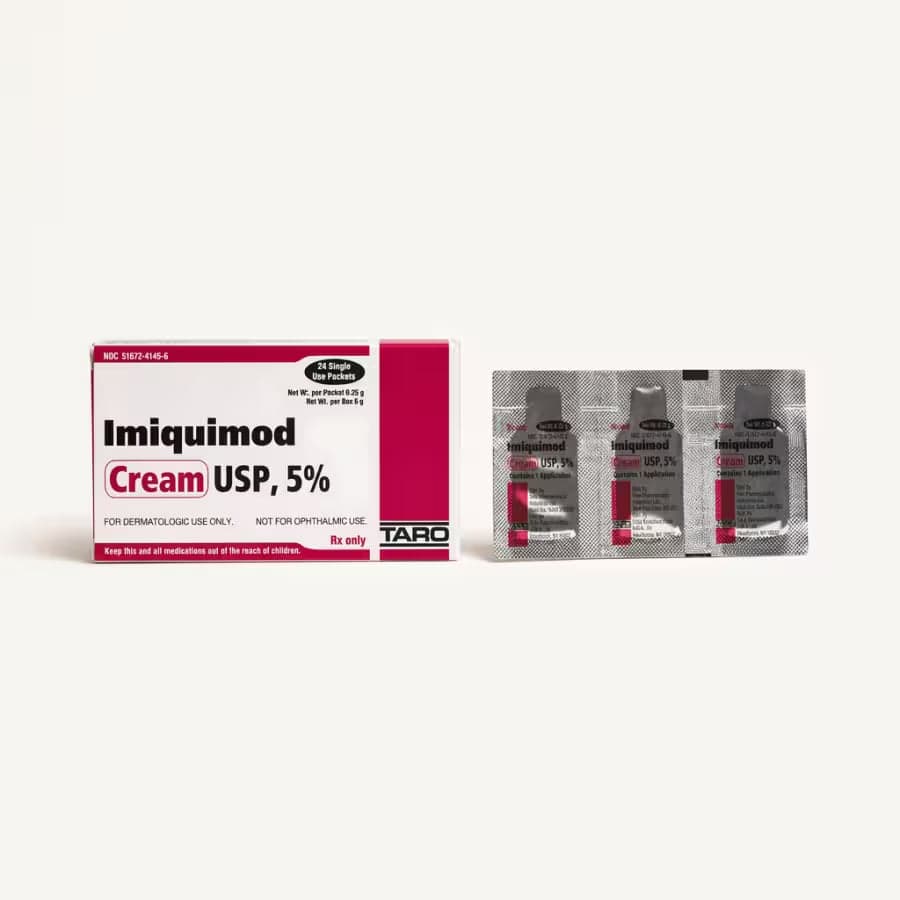
Imiquimod is a prescription cream that clears sun damage and some early skin cancers by waking up your own immune system. You may know it by the brand name Aldara. Instead of attacking cells directly, it signals your body to recognize the abnormal cells and clear them. It is used most for actinic keratoses, the rough, scaly precancers caused by years of sun.1
Key points
- Imiquimod switches on your immune system to clear sun-damaged and some early-cancerous cells.2
- It works by causing a strong but temporary skin reaction where the damage is, then the skin heals.2
- For a basal cell carcinoma it can work, but surgery cures more, so the spot must be checked first.3
What is imiquimod?
Imiquimod is an immune-response cream. It does not poison cells the way chemotherapy does. Instead it acts like an alarm in the skin. It prompts your immune system to find and clear the sun-damaged cells.2 The reaction spreads through the whole treated area. So it can reach early damage you cannot yet see. This is why it is called a field treatment, not a one-spot fix. It is a cream, so there is no cutting and no stitches.
How you use it
You put a thin layer on the treatment area at home, a few times a week for several weeks. The exact plan depends on what is being treated. In the actinic keratosis trials, people used it two or three times a week for about 16 weeks.45 For a superficial basal cell carcinoma, the course is usually daily for about six weeks.6 Your clinician will tell you where, how often, and how long to apply it.
What imiquimod treats
Imiquimod is used for sun-damaged and some early-cancerous skin. Here is what it treats and how well the research shows it works, strongest first.
Grouped by how strongly this treatment is indicated. Up bars show how well it works for each condition; green means better. Tap a study count to see the sources. Your dermatologist decides what's right for you.
Clearing a sun-damaged field is also a form of prevention, because some actinic keratoses, left alone, can turn into squamous cell carcinoma.1 Imiquimod is not used for nodular or deeper basal cell carcinomas, invasive skin cancers, or melanoma, which need surgery or other treatments.7
What the reaction looks like
Imiquimod is supposed to make the treated skin look worse before it looks better. Over the first week or two the area becomes red, crusted, and sometimes raw, right where the sun damage or the lesion is. That reaction is the immune system at work, and it is expected.2 It then settles over the following weeks as the skin heals. The reaction can look alarming, but your clinician can tell you how to care for the skin and when the course is done.
How well it works
The table above summarizes the evidence by condition. The detail below adds the key numbers.
For actinic keratoses, imiquimod is a guideline-recommended field treatment.1 In the main trials it cleared all visible spots in about 45% to 57% of people. A dummy cream cleared only a few percent.458 A review of five trials put full clearance at about half of people.2 Its strength is staying power and a good look afterward. In one year-long trial, 73% of the treated area stayed clear, more than with 5-FU or freezing.9 One honest point: when four field treatments were compared, 5-FU kept more people clear at a year. So imiquimod is one strong option among several.1011
For a superficial basal cell carcinoma, imiquimod can work, but surgery cures more. In a phase-3 trial it cleared about 80% of these thin cancers.6 Its results also lasted well, with 80.5% still clear at five years.1213 But head-to-head, surgery won: 98% success versus 84% for the cream at three years.3 A large review agrees. Surgery recurs least, and among the creams imiquimod has the best evidence.14
For Bowen's disease (squamous cell carcinoma in situ), one small trial cleared 73% of patches with imiquimod and none with a dummy cream. It is a reasonable option, though the evidence is still limited.1516 For lentigo maligna, an early surface form of melanoma, imiquimod is used only in selected cases when surgery is not possible. It needs close follow-up, because a small share of these spots turn out to be deeper.1718
People with a suppressed immune system, such as organ transplant recipients, get many sun-damage spots. In a trial in transplant patients, imiquimod cleared the spots in about 62%. It did not harm the transplanted organ.1920
Other options patients ask about
People often look for something gentler than the imiquimod reaction, or a "natural" way to avoid treatment. Here is what the evidence shows.
- 5-FU, photodynamic therapy, freezing, and diclofenac gel are real, proven alternatives. For sun damage, 5-FU tends to clear more spots. Imiquimod can leave a better look and longer-lasting clearance.910 They are worth discussing, but they are reasons to pick a different treatment, not to skip treatment.
- Surgery is the most effective choice for a confirmed basal cell carcinoma or squamous cell cancer.3 A cream may be chosen for small, low-risk, surface-level tumors or by patient preference, but it is not an equal substitute for removing a cancer.14
- A "natural" vitamin C cream has been tested against imiquimod in only one small study, which is not enough to choose it over a proven treatment for a cancer.21
- Black salve and similar corrosive pastes are harmful. They are sold online as a skin cancer cure, but the claims are not backed by evidence, and serious injuries have been reported. They can also leave cancer behind under a scab where no one can see it.2223
Why getting the spot checked first matters
Imiquimod treats the surface. That is the whole reason a diagnosis comes first. A spot that looks like a simple precancer can be something deeper. For a real cancer, surgery cures more.3 And a small share of lentigo maligna treated with cream still turns out to be invasive melanoma.18 Treating yourself with a cream, an acid, or a corrosive paste can destroy the tissue a doctor needs. It can also let a real cancer grow.22 A skin exam and, when needed, a biopsy come first.
Who should not use it
Imiquimod is a prescription medicine with real cautions:
- Pregnancy and breastfeeding. Tell your clinician if you are or could be pregnant, or are breastfeeding, so you can decide together.
- A suppressed immune system. Imiquimod works through the immune system. It has been studied and used in transplant patients without harming the transplanted organ, but it needs a clinician's guidance in anyone on immune-suppressing medicine.19
- A strong skin reaction. The redness and crusting are expected, but a very heavy reaction can spread beyond the treated area. Some people also get short-lived flu-like feelings during a course. Tell your clinician if the reaction is hard to manage.2
When to see a doctor
Call your clinician if the reaction becomes very painful, oozing, or looks infected, if it spreads well beyond the treated area, or if a spot does not heal after the course is finished. And see a clinician before starting any cream on a spot that is new, changing, bleeding, or different from your others, so it can be properly checked first.
Worried about a spot?
SpotDoc offers full-body skin cancer screening in Brownwood Square, The Villages. No referral needed for most plans.
Frequently asked questions
Is imiquimod chemotherapy? No. It is an immune-response cream. Instead of poisoning cells, it prompts your own immune system to clear the abnormal ones.2
Why does my skin look so bad while using it? That reaction is the treatment working. Imiquimod stirs up the immune system in the treated area, so the skin gets red and crusted before it heals over a few weeks.2
Can I treat my basal cell carcinoma with cream instead of surgery? Sometimes, for a small surface-level one, but surgery cures more. In a head-to-head trial, surgery succeeded 98% of the time versus 84% for the cream, so the choice should be made with your clinician after the diagnosis is confirmed.3
How does it compare with 5-FU for sun damage? For actinic keratoses, 5-FU kept more people clear at a year, while imiquimod can leave a better cosmetic result and longer-lasting clearance.109
Can I use a natural remedy instead? There is no proven natural substitute. A vitamin C cream was tested in only one small study, and corrosive "black salve" pastes are dangerous and can hide a cancer. Get the spot checked and use a treatment that is known to work.2122
Questions to ask your clinician
- Has this spot been examined, and does it need a biopsy before I treat it?
- For my spot, is imiquimod, another cream, or surgery the better choice?
- What schedule fits my skin and my daily routine?
- What should the reaction look like, and how do I care for the skin?
- When should I call you, and when is the course finished?
Imiquimod is one of several field treatments. Others include 5-fluorouracil and photodynamic therapy, compared side by side in the actinic keratosis guide. The best choice depends on what is being treated, your schedule, and how your skin tolerates treatment. A thorough skin cancer screening is the place to start.
Reviewed by Tyler Long, DO. Last reviewed 2026-06-24.
Update log
How this guide has changed since it was first published.
- September 29, 2026Guide published.
References
Every statement on this page is backed by the peer-reviewed sources below — each links to the original study. Numbers match the citations in the text and the grids above.
- Eisen DB, Asgari MM, Bennett DD, et al. Guidelines of care for the management of actinic keratosis. J Am Acad Dermatol. 2021;85(4):e209–e233.View source
- Hadley G, Derry S, Moore RA. Imiquimod for actinic keratosis: systematic review and meta-analysis. J Invest Dermatol. 2006;126(6):1251–1255.View source
- Bath-Hextall F, Ozolins M, Armstrong SJ, et al. Surgical excision versus imiquimod 5% cream for nodular and superficial basal-cell carcinoma (SINS): a multicentre, non-inferiority, randomised controlled trial. Lancet Oncol. 2014;15(1):96–105.View source
- Lebwohl M, Dinehart S, Whiting D, et al. Imiquimod 5% cream for the treatment of actinic keratosis: results from two phase III, randomized, double-blind, parallel group, vehicle-controlled trials. J Am Acad Dermatol. 2004;50(5):714–721.View source
- Szeimies RM, Gerritsen MJ, Gupta G, et al. Imiquimod 5% cream for the treatment of actinic keratosis: results from a phase III, randomized, double-blind, vehicle-controlled, clinical trial with histology. J Am Acad Dermatol. 2004;51(4):547–555.View source
- Schulze HJ, Cribier B, Requena L, et al. Imiquimod 5% cream for the treatment of superficial basal cell carcinoma: results from a randomized vehicle-controlled phase III study in Europe. Br J Dermatol. 2005;152(5):939–947.View source
- Verkouteren BJA, Nelemans PJ, Sinx KAE, et al. Imiquimod cream preceded by superficial curettage vs surgical excision for nodular basal cell carcinoma: a secondary analysis of a randomized clinical trial. JAMA Dermatol. 2025;161(3):299–304.View source
- Korman N, Moy R, Ling M, et al. Dosing with 5% imiquimod cream 3 times per week for the treatment of actinic keratosis: results of two phase 3, randomized, double-blind, parallel-group, vehicle-controlled trials. Arch Dermatol. 2005;141(4):467–473.View source
- Krawtchenko N, Roewert-Huber J, Ulrich M, Mann I, Sterry W, Stockfleth E. A randomised study of topical 5% imiquimod vs. topical 5-fluorouracil vs. cryosurgery in immunocompetent patients with actinic keratoses: a comparison of clinical and histological outcomes including 1-year follow-up. Br J Dermatol. 2007;157 Suppl 2:34–40.View source
- Jansen MHE, Kessels JPHM, Nelemans PJ, et al. Randomized Trial of Four Treatment Approaches for Actinic Keratosis. N Engl J Med. 2019;380(10):935–946.View source
- Ezzedine K, Painchault C, Brignone M. Systematic Literature Review and Network Meta-analysis of the Efficacy and Acceptability of Interventions in Actinic Keratoses. Acta Derm Venereol. 2021;101(1):adv00358.View source
- Arits AHMM, Mosterd K, Essers BAB, et al. Photodynamic therapy versus topical imiquimod versus topical fluorouracil for treatment of superficial basal-cell carcinoma: a single blind, non-inferiority, randomised controlled trial. Lancet Oncol. 2013;14(7):647–654.View source
- Jansen MHE, Mosterd K, Arits AHMM, et al. Five-year results of a randomized controlled trial comparing effectiveness of photodynamic therapy, topical imiquimod, and topical 5-fluorouracil in patients with superficial basal cell carcinoma. J Invest Dermatol. 2018;138(3):527–533.View source
- Thomson J, Hogan S, Leonardi-Bee J, Williams HC, Bath-Hextall FJ. Interventions for basal cell carcinoma of the skin. Cochrane Database Syst Rev. 2020;11(11):CD003412.View source
- Patel GK, Goodwin R, Chawla M, et al. Imiquimod 5% cream monotherapy for cutaneous squamous cell carcinoma in situ (Bowen's disease): a randomized, double-blind, placebo-controlled trial. J Am Acad Dermatol. 2006;54(6):1025–1032.View source
- Shimizu I, Cruz A, Chang KH, Dufresne RG. Treatment of squamous cell carcinoma in situ: a review. Dermatol Surg. 2011;37(10):1394–1411.View source
- Tzellos T, Kyrgidis A, Mocellin S, Chan AW, Pilati P, Apalla Z. Interventions for melanoma in situ, including lentigo maligna. Cochrane Database Syst Rev. 2014;(12):CD010308.View source
- Tio D, van der Woude J, Prinsen CAC, Jansma EP, Hoekzema R, van Montfrans C. A systematic review on the role of imiquimod in lentigo maligna and lentigo maligna melanoma: need for standardization of treatment schedule and outcome measures. J Eur Acad Dermatol Venereol. 2017;31(4):616–624.View source
- Ulrich C, Bichel J, Euvrard S, et al. Topical immunomodulation under systemic immunosuppression: results of a multicentre, randomized, placebo-controlled safety and efficacy study of imiquimod 5% cream for the treatment of actinic keratoses in kidney, heart, and liver transplant patients. Br J Dermatol. 2007;157 Suppl 2:25–31.View source
- Heppt MV, Steeb T, Niesert AC, et al. Local interventions for actinic keratosis in organ transplant recipients: a systematic review. Br J Dermatol. 2019;180(1):43–50.View source
- Burke B, Bailie JE. Randomized trial of topical ascorbic acid in DMSO versus imiquimod for the treatment of basal cell carcinoma. Biomed Pharmacother. 2022;148:112710.View source
- Osswald SS, Elston DM, Farley MF, et al. Self-treatment of a basal cell carcinoma with 'black and yellow salve'. J Am Acad Dermatol. 2005;53(3):509–511.View source
- Bozung AK, Ko AC, Gallo RA, Rong AJ. Persistent basal cell carcinoma following self-treatment with a 'natural cure,' Sanguinaria canadensis. Ophthalmic Plast Reconstr Surg. 2021;37(2):e71–e73.View source
- Hong AM, Lo SN, Fogarty GB, et al. Radiotherapy versus imiquimod for complex lentigo maligna: a phase 3 randomized clinical trial. J Am Acad Dermatol. 2025;93(5):1251–1260.View source