

For general education, not medical advice. This guide can’t diagnose you or replace care from your own clinician. If you’re worried about a spot or symptom, see a board-certified dermatologist.
Photodynamic therapy (PDT) is an in-office treatment that uses a light-activated medicine to clear sun-damaged and precancerous skin. It is most often used for actinic keratoses, the rough, scaly precancers caused by years of sun, and it treats a whole sun-damaged area at once rather than freezing spots one at a time.
Key points
- PDT uses a light-activated medicine to destroy sun-damaged and precancerous cells across a whole area.1
- It is mainly used for actinic keratoses and usually heals with a good cosmetic result.2
- A gentler daylight version clears about as well as the in-office lamp, with much less stinging.3
What is photodynamic therapy?
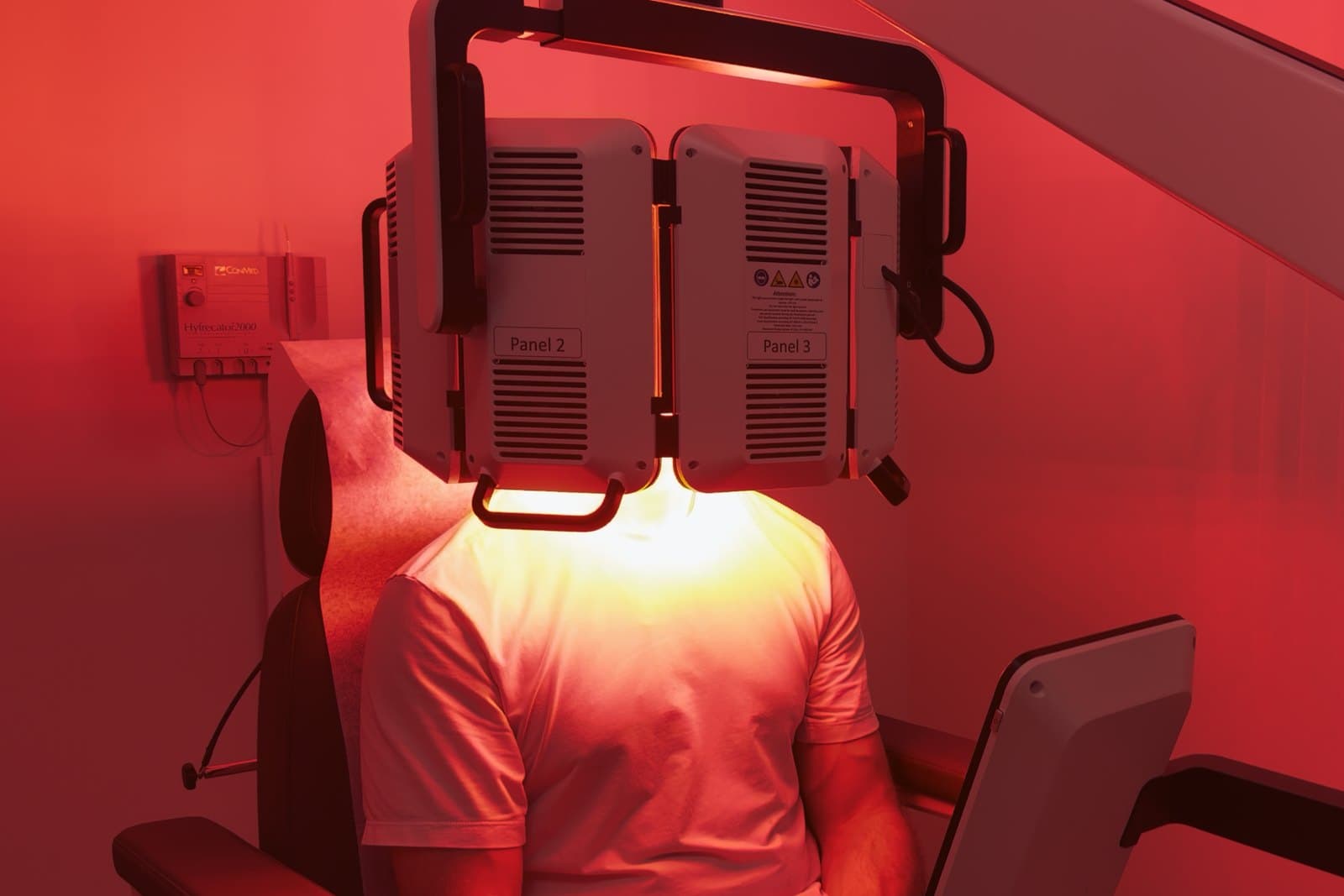
PDT combines two things: a medicine and light. A cream or liquid is put on the skin, the damaged cells soak it up, and then a special light switches it on to destroy those cells. Because healthy skin absorbs far less of the medicine, the effect is concentrated where the sun damage is. It is non-surgical, with no cut and no stitches.
How it works
- The medicine. A photosensitizer (a light-sensitive medicine such as aminolevulinic acid, or ALA) is applied to the skin. Rapidly dividing, sun-damaged cells take it up and turn it into a compound that makes them sensitive to light.
- Incubation. The medicine is left on for a while so it builds up in the abnormal cells.
- Light. The area is exposed to a specific light (often blue or red). The light activates the medicine, which produces a burst of oxygen that destroys the targeted cells.
What PDT treats
PDT treats sun-damaged and early-cancerous skin across a whole area at once, rather than one spot at a time. It is used most for actinic keratoses, especially when there are many in one area ("field cancerization"). Here is what it treats and how well the research shows it works, strongest first.
Grouped by how strongly this treatment is indicated. Up bars show how well it works for each condition; green means better. Tap a study count to see the sources. Your dermatologist decides what's right for you.
Clearing a sun-damaged field is also a form of skin cancer prevention, because some actinic keratoses, left alone, can turn into squamous cell carcinoma. PDT is not used for invasive (deeper) skin cancers or for melanoma, which need other treatments.4
What to expect at your visit
A session is straightforward but takes a couple of hours start to finish:
- Prep. The skin is cleaned and sometimes lightly exfoliated so the medicine absorbs evenly.
- Medicine applied. The photosensitizer is put on the treatment area.
- Incubation. You wait while it absorbs, from a short period up to a couple of hours.
- Light. You sit under the light for about 10 to 20 minutes. Many people feel stinging or burning during this step; a fan or cool air helps.
- Home. It is done in one visit, though a full course often includes a second session a few weeks later for the best clearance.
Side effects and recovery
Afterward the treated skin behaves like it has a strong sunburn: redness, swelling, stinging, then crusting and peeling, which usually settles over about a week as fresh skin comes through. The most important aftercare rule is strict sun avoidance for about 48 hours, because the medicine leaves your skin very light-sensitive and ordinary daylight, even through a window, can cause a strong reaction during that window.
Conventional vs. daylight PDT
There are two ways to deliver the light:
- Conventional (in-office lamp) PDT uses a blue or red light in the clinic. It is effective but can sting during the light exposure.
- Daylight PDT uses natural daylight to activate the medicine instead of a lamp. Studies find it clears actinic keratoses about as well as the lamp while causing much less pain, with the trade-off that it depends on suitable weather and a specific exposure window.3
Worried about a spot?
SpotDoc offers full-body skin cancer screening in Brownwood Square, The Villages. No referral needed for most plans.
Blue light vs. red light
The activating light comes in two colors, and which one is used depends on what is being treated:
- Blue light works mainly at the skin's surface. It is the common choice for actinic keratoses on the face and scalp.1
- Red light reaches a little deeper into the skin, so it is often chosen for thicker spots or early skin cancers such as Bowen's disease and superficial basal cell carcinoma.4
For actinic keratoses, the two work about equally well. In a head-to-head randomized trial, blue and red light cleared a similar share of people (about 85 percent), with only small differences in stinging.5
How well it works
The table above summarizes the evidence by condition. The detail below adds the key numbers.
For actinic keratoses, PDT clears most treated spots. In one large study about 89% of people had a strong response by week 12,1 and a newer gel cleared spots in about 78% of people.6 Head-to-head with freezing, PDT clears about the same share of spots (roughly 7 in 10) but leaves a better cosmetic result and higher satisfaction.7 The gentler daylight version clears about as well as the in-office lamp with much less pain.3 Major guidelines list PDT as an effective option for actinic keratoses.8
For Bowen's disease, a trial found PDT cleared about 80% of patches at one year, more than freezing (67%) or 5-FU cream (69%), with the best cosmetic result of the three.9 For superficial basal cell carcinoma, PDT clears most thin lesions and looks better than surgery, but surgery has fewer recurrences, so PDT is reserved for selected, surface-level cases.104
For how PDT stacks up against creams and freezing for actinic keratoses, see the actinic keratosis guide.
Is PDT right for you?
PDT is a strong fit for people with many actinic keratoses or widespread sun damage in one area, where freezing each spot would be impractical. It is one of several field treatments; others include the creams 5-fluorouracil and imiquimod, compared side by side in the actinic keratosis guide. The best choice depends on how much sun damage you have, your schedule, and how your skin tolerates treatment. A thorough skin cancer screening is the place to start that conversation.
Frequently asked questions
Does photodynamic therapy hurt? The light step can sting or burn, and a fan or cool air helps. The gentler daylight version is nearly painless. Afterward the skin feels like a sunburn for a few days.
How many sessions will I need? Most people have two sessions a few weeks apart for the best clearance, then return for touch-ups over time as new sun damage appears.
How long is the downtime? The treated skin is red, then crusts and peels, usually settling over about a week. Plan for strict sun avoidance for about 48 hours right after.
Will PDT get rid of all my spots? It clears most treated spots, but not always every one, and new spots can form later from ongoing sun damage. Ongoing sun protection and regular skin checks remain important.
Is PDT used for skin cancer? It is mainly for actinic keratoses, and in selected cases for superficial basal cell carcinoma and squamous cell carcinoma in situ (Bowen's disease). It is not used for invasive skin cancers or melanoma.
Questions to ask your dermatologist
- Is PDT a better fit for me than a field cream or freezing?
- Will I need one session or two?
- What should I expect for redness and downtime, and when can I be back in the sun?
- How will we keep an eye on the area afterward?
Reviewed by Tyler Long, DO. Last updated June 2026.
Update log
How this guide has changed since it was first published.
- July 21, 2026Guide published.
References
Every statement on this page is backed by the peer-reviewed sources below — each links to the original study. Numbers match the citations in the text and the grids above.
- Piacquadio DJ, Chen DM, Farber HF, et al. Photodynamic therapy with aminolevulinic acid topical solution and visible blue light in the treatment of multiple actinic keratoses of the face and scalp: investigator-blinded, phase 3, multicenter trials. Arch Dermatol. 2004;140(1):41–46.View source
- Gupta AK, Paquet M, Villanueva E, Brintnell W. Interventions for actinic keratoses. Cochrane Database Syst Rev. 2012;12:CD004415.View source
- Mei X, Wang L, Zhang R, Zhong S. Daylight versus conventional photodynamic therapy for the treatment of actinic keratosis: A meta-analysis of randomized controlled trials. Photodiagnosis Photodyn Ther. 2019;25:23–28.View source
- Morton CA, Szeimies RM, Basset-Séguin N, et al. European Dermatology Forum guidelines on topical photodynamic therapy 2019 part 1: treatment delivery and established indications — actinic keratoses, Bowen’s disease and basal cell carcinomas. J Eur Acad Dermatol Venereol. 2019;33(12):2225–2238.View source
- Gholam P, Bosselmann I, Enk A, Fink C. Impact of red versus blue light on tolerability and efficacy of PDT: a randomized controlled trial. J Dtsch Dermatol Ges. 2018;16(6):711–717.View source
- Dirschka T, Radny P, Dominicus R, et al. Photodynamic therapy with BF-200 ALA for the treatment of actinic keratosis: results of a multicentre, randomized, observer-blind phase III study in comparison with a registered methyl-5-aminolaevulinate cream and placebo. Br J Dermatol. 2012;166(1):137–146.View source
- Szeimies RM, Karrer S, Radakovic-Fijan S, et al. Photodynamic therapy using topical methyl 5-aminolevulinate compared with cryotherapy for actinic keratosis: a prospective, randomized study. J Am Acad Dermatol. 2002;47(2):258–262.View source
- Eisen DB, Asgari MM, Bennett DD, et al. Guidelines of care for the management of actinic keratosis. J Am Acad Dermatol. 2021;85(4):e209–e233.View source
- Morton C, Horn M, Leman J, et al. Comparison of topical methyl aminolevulinate photodynamic therapy with cryotherapy or fluorouracil for treatment of squamous cell carcinoma in situ: results of a multicenter randomized trial. Arch Dermatol. 2006;142(6):729–735.View source
- Basset-Séguin N, Ibbotson SH, Emtestam L, et al. Topical methyl aminolaevulinate photodynamic therapy versus cryotherapy for superficial basal cell carcinoma: a 5-year randomized trial. Eur J Dermatol. 2008;18(5):547–553.View source