

For general education, not medical advice. This guide can’t diagnose you or replace care from your own clinician. If you’re worried about a spot or symptom, see a board-certified dermatologist.
Cryotherapy, also called cryosurgery, is a quick in-office treatment that freezes a skin spot with liquid nitrogen. The cold destroys the treated cells. Over the next week or two the spot blisters, crusts, and falls off, and fresh skin heals in. It is a very common skin procedure because it is fast, low cost, and needs no cutting and no numbing shot.
Key points
- Cryotherapy freezes a spot so the treated cells die, then the skin blisters and heals over a week or two.1
- It is used most for actinic keratoses, warts, and harmless growths, and major guidelines back it for sun-damage spots.2
- It treats one spot at a time, so creams that treat a whole area can keep more of a sun-damaged field clear over a year.3
What is cryotherapy?
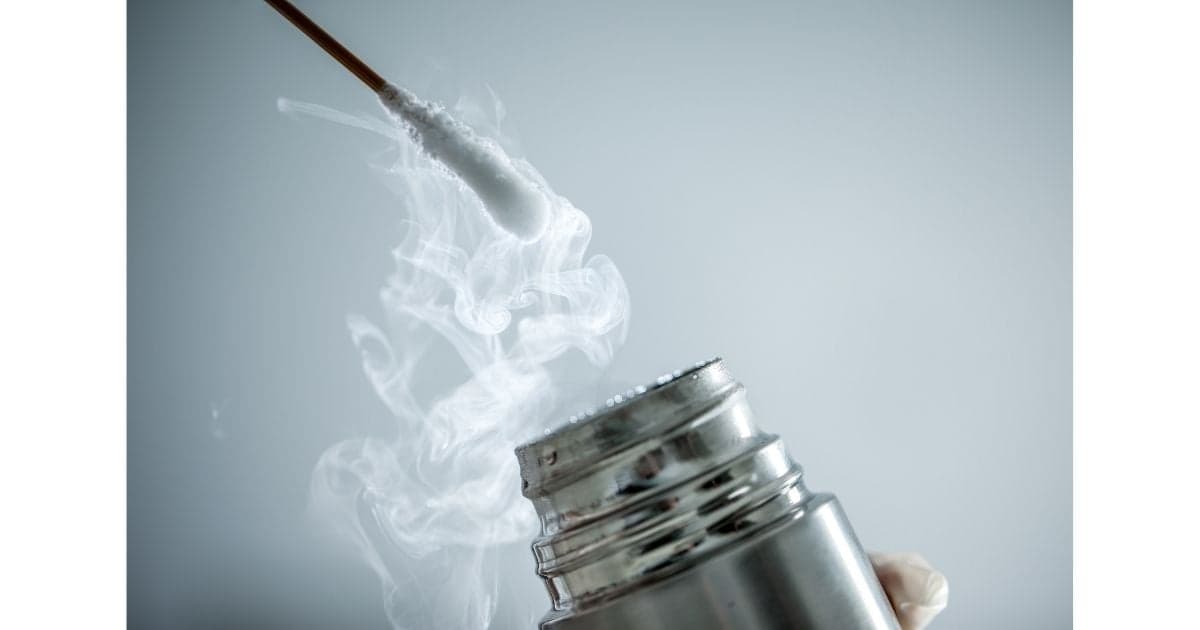
Cryotherapy uses liquid nitrogen, which is about minus 196 degrees Celsius. The clinician sprays it on the spot or touches it with a cold probe for a few seconds. Ice forms inside the cells and destroys them. A small rim of normal skin is frozen too, which is why a blister can form around the spot.1 Because it only reaches the surface, freezing suits thin, surface-level spots, not deep growths.
How it's done
The visit is short and usually needs no numbing. Here is the typical process:
- The clinician aims a fine spray or probe at the spot and freezes it for a few seconds.
- A longer freeze destroys more tissue, so the time is matched to the spot.4
- Sometimes the spot is frozen, allowed to thaw, then frozen again. This double cycle is used for tougher spots.5
- It stings or burns for a moment, then aches a little afterward.
Keeping the freeze under about 30 seconds avoids most lasting color change in the skin.1
What cryotherapy treats
Cryotherapy is used for a range of surface spots, once a clinician is confident what the spot is. Here is what it treats and how well the research shows it works, strongest first.
Grouped by how strongly this treatment is indicated. Up bars show how well it works for each condition; green means better. Tap a study count to see the sources. Your dermatologist decides what's right for you.
Freezing works best for actinic keratoses, the rough precancers caused by years of sun, and for common warts and harmless growths. It can also treat some thin, low-risk skin cancers in selected cases, but those decisions belong with a clinician, because freezing leaves no tissue to check the edges.
What it feels like and how it heals
The freeze itself stings for several seconds, like a hard cold pinch. Over the next day a blister or sore often forms where the spot was. It then dries to a scab and falls off over one to two weeks, leaving fresh skin. A treated spot can stay pink for a while, and sometimes heals a shade lighter or darker than the skin around it. That color change is more likely with a longer freeze and on darker skin.1 A lightening cream can help fade dark marks after freezing sun spots.6
How well it works
The table above sums up the evidence by condition. The detail below adds the key numbers.
For actinic keratoses, freezing clears about two-thirds of treated spots, and a longer freeze clears more.4 Major guidelines strongly recommend it.2 One honest caveat is the difference between a spot and a field. In a year-long head-to-head trial, freezing cleared 68% of treated spots at the start, but only about 4% of people had the whole treated area still clear at a year, versus 33% with 5-FU cream and 73% with imiquimod.3 Against a light-based treatment, freezing cleared 68% of spots versus 91% for photodynamic therapy, which also looked better afterward.7 Many people still prefer freezing for a few spots because it is quick and done on the spot, while creams and light treatments suit a whole sun-damaged area.8
For common warts, freezing cleared 49% of warts in a primary-care trial, better than salicylic acid at 15% or waiting at 8%.9 For warts on the sole of the foot, though, freezing worked no better than salicylic acid, with both clearing about 14%.10
For thin basal cell carcinomas in selected cases, freezing can reach high cure rates in experienced hands. A double freeze cleared 95% of facial tumours versus 79% for a single freeze.5 Larger series report about 91% to 95% cure at five years with good cosmetic results.1112 Even so, margin-controlled surgery is the standard for most skin cancers, because freezing cannot check whether the edges are clear.13 For Bowen's disease, a surface skin cancer, freezing works but comes back more often and hurts more than scraping the spot off, especially on the lower leg.14
Other options patients ask about
People often look for a way to freeze a spot at home, or a gentler alternative. Here is what the evidence shows.
- Over-the-counter "freeze-off" wart kits (the spray cans sold for warts) are a real but weaker tool, and only for warts. They do not get as cold as the liquid nitrogen used in the office, and they are not meant for moles, sun spots, or anything that might be skin cancer. A clear, ordinary wart is a reasonable place to try one. A stubborn wart usually does better with an office freeze.
- Freezing a mole, a new or changing spot, or any "growth" yourself is not safe. Freezing destroys the spot without leaving anything to test, so if it was a skin cancer, the proof is gone and the diagnosis is delayed.15 Get it looked at first.
- At-home liquid nitrogen or freezing a spot "longer" to be sure mainly raises the risk of a burn or a scar, with no gain over a supervised freeze, and still no tissue to check.1
- "Natural" freezing or wart remedies have no good evidence for clearing a precancer or a skin cancer, and home acids can burn the skin and hide a growing spot.
Why getting the spot checked first matters
Freezing treats the surface and leaves nothing behind to examine. That is the whole reason a diagnosis comes first. A spot that looks like a simple precancer, a wart, or a harmless growth can sometimes be a melanoma or a deeper cancer in disguise. A melanoma has been mistaken for a harmless growth and frozen, which can worsen and delay the diagnosis.15 A frozen pigmented spot is also harder to read later.16 Even trained clinicians sometimes pick freezing in error for a spot that was actually skin cancer, most often a solitary pigmented spot.17 A skin exam and, when needed, a biopsy come before any freeze.
Side effects and who should be careful
Cryotherapy is safe for most people, but it has trade-offs:
- Pain and blistering are normal. The spot stings during the freeze and can blister, weep, and scab as it heals.
- Color change. The healed spot can be lighter or darker than nearby skin. This is more likely on darker skin and after a longer freeze, so freezing is used with extra care on the face and on darker skin.1
- Hair loss and nerve sensitivity. A deep freeze over a hair-bearing or nerve-rich area can thin the hair or briefly affect feeling, which is why time and depth are matched to the spot.1
- A few medical conditions make freezing a poor choice, such as certain cold-sensitivity disorders. Tell your clinician your history.
When to see a doctor
Call your clinician if a frozen spot becomes very painful, oozing, or looks infected, or if it does not heal after a few weeks. And see a clinician before freezing anything yourself if a spot is new, changing, bleeding, or different from your others, so it can be checked first.
Worried about a spot?
SpotDoc offers full-body skin cancer screening in Brownwood Square, The Villages. No referral needed for most plans.
Frequently asked questions
Does cryotherapy hurt? It stings or burns for several seconds during the freeze, then aches a little. Most people tolerate it without numbing.1
How long does it take to heal? The spot usually blisters or scabs, then falls off over one to two weeks, leaving fresh skin. A larger or deeper freeze takes longer.14
Will the spot come back? It can. Freezing clears about two-thirds of sun-damage spots, and sun-damaged skin keeps making new ones, so spots are sometimes re-treated over time.43
Can I just use a freeze-off kit from the drugstore? For an obvious common wart, a kit is reasonable, though it is weaker than an office freeze. Never use one on a mole or a new or changing spot, because freezing can hide a skin cancer.15
Will it leave a mark? Sometimes. A treated spot can heal a shade lighter or darker, more often on darker skin and after a longer freeze.1
Is freezing as good as surgery for skin cancer? For thin, low-risk cancers in selected cases it can cure well, but freezing cannot check the edges, so margin-controlled surgery is the standard for most skin cancers.135
Questions to ask your clinician
- Has this spot been examined, and does it need a biopsy before it is frozen?
- Is freezing the best choice for this spot, or would a cream, scraping, or surgery work better?
- What should the spot look like as it heals, and how do I care for it?
- Could it leave a lighter or darker mark, and does my skin tone change the plan?
- When should I call you, and might it need a second treatment?
Cryotherapy is one of several ways to treat sun-damage spots and surface growths. Others include photodynamic therapy and creams like 5-fluorouracil, compared side by side in the actinic keratosis guide. The best choice depends on the spot, how many you have, and your skin. A thorough skin cancer screening is the place to start.
Reviewed by Tyler Long, DO. Last reviewed 2026-06-23.
Update log
How this guide has changed since it was first published.
- October 20, 2026Guide published.
References
Every statement on this page is backed by the peer-reviewed sources below — each links to the original study. Numbers match the citations in the text and the grids above.
- Zimmerman EE, Crawford P. Cutaneous cryosurgery. Am Fam Physician. 2012;86(12):1118–1124.
- Eisen DB, Asgari MM, Bennett DD, et al. Guidelines of care for the management of actinic keratosis. J Am Acad Dermatol. 2021;85(4):e209–e233.View source
- Krawtchenko N, Roewert-Huber J, Ulrich M, Mann I, Sterry W, Stockfleth E. A randomised study of topical 5% imiquimod vs. topical 5-fluorouracil vs. cryosurgery in immunocompetent patients with actinic keratoses: a comparison of clinical and histological outcomes including 1-year follow-up. Br J Dermatol. 2007;157 Suppl 2:34–40.View source
- Thai KE, Fergin P, Freeman M, et al. A prospective study of the use of cryosurgery for the treatment of actinic keratoses. Int J Dermatol. 2004;43(9):687–692.View source
- Mallon E, Dawber R. Cryosurgery in the treatment of basal cell carcinoma. Assessment of one and two freeze-thaw cycle schedules. Dermatol Surg. 1996;22(10):854–858.
- Hexsel D, Hexsel C, Porto MD, Siega C. Triple combination as adjuvant to cryotherapy in the treatment of solar lentigines: investigator-blinded, randomized clinical trial. J Eur Acad Dermatol Venereol. 2015;29(1):128–133.View source
- Freeman M, Vinciullo C, Francis D, et al. A comparison of photodynamic therapy using topical methyl aminolevulinate (Metvix) with single cycle cryotherapy in patients with actinic keratosis: a prospective, randomized study. J Dermatolog Treat. 2003;14(2):99–106.View source
- Tierney EP, Eide MJ, Jacobsen G, Ozog D. Photodynamic therapy for actinic keratoses: survey of patient perceptions of treatment satisfaction and outcomes. J Cosmet Laser Ther. 2008;10(2):81–86.View source
- Bruggink SC, Gussekloo J, Berger MY, et al. Cryotherapy with liquid nitrogen versus topical salicylic acid application for cutaneous warts in primary care: randomized controlled trial. CMAJ. 2010;182(15):1624–1630.View source
- Cockayne S, Hewitt C, Hicks K, et al. Cryotherapy versus salicylic acid for the treatment of plantar warts (verrucae): a randomised controlled trial. BMJ. 2011;342:d3271.View source
- Bernardeau K, Derancourt C, Cambie M, et al. Cryosurgery of basal cell carcinoma: a study of 358 patients. Ann Dermatol Venereol. 2000;127(2):175–179.
- Buckley D, Marczuk C, Kennedy T. Cryosurgery for basal cell carcinoma treated in primary care. Ir J Med Sci. 2020;189(4):1183–1187.View source
- Berking C, Hauschild A, Kölbl O, et al. Basal cell carcinoma—treatments for the commonest skin cancer. Dtsch Arztebl Int. 2014;111(22):389–395.View source
- Ahmed I, Berth-Jones J, Charles-Holmes S, et al. Comparison of cryotherapy with curettage in the treatment of Bowen's disease: a prospective study. Br J Dermatol. 2000;143(4):759–766.View source
- Kerouach A, Hali F, Belanouane S, et al. Verrucous melanoma of the scalp initially misdiagnosed as seborrheic keratosis. Cureus. 2022;14(9):e29098.View source
- Xie DY, Costello CM, Liang HJ, et al. Melanoma mimicking Rosai-Dorfman disease. J Cutan Pathol. 2018;45(5):355–359.View source
- Graells J, Espinola A, Barrio C, et al. Minor cutaneous ambulatory surgery and cryotherapy. Comparative study between a dermatologist and family physicians. Actas Dermosifiliogr. 2007;98(3):171–177.