

This June, Dr. Tyler Long, DO, had the privilege of speaking to a full room of about 250 Villages residents at a community event hosted by the Villages Homeowners Advocates (VHA). The talk — Dermatology of the 21st Century — covered how skin cancer is found and treated today, and why early detection matters so much for people who live where we do.
If you couldn't make it, here are the takeaways worth keeping.
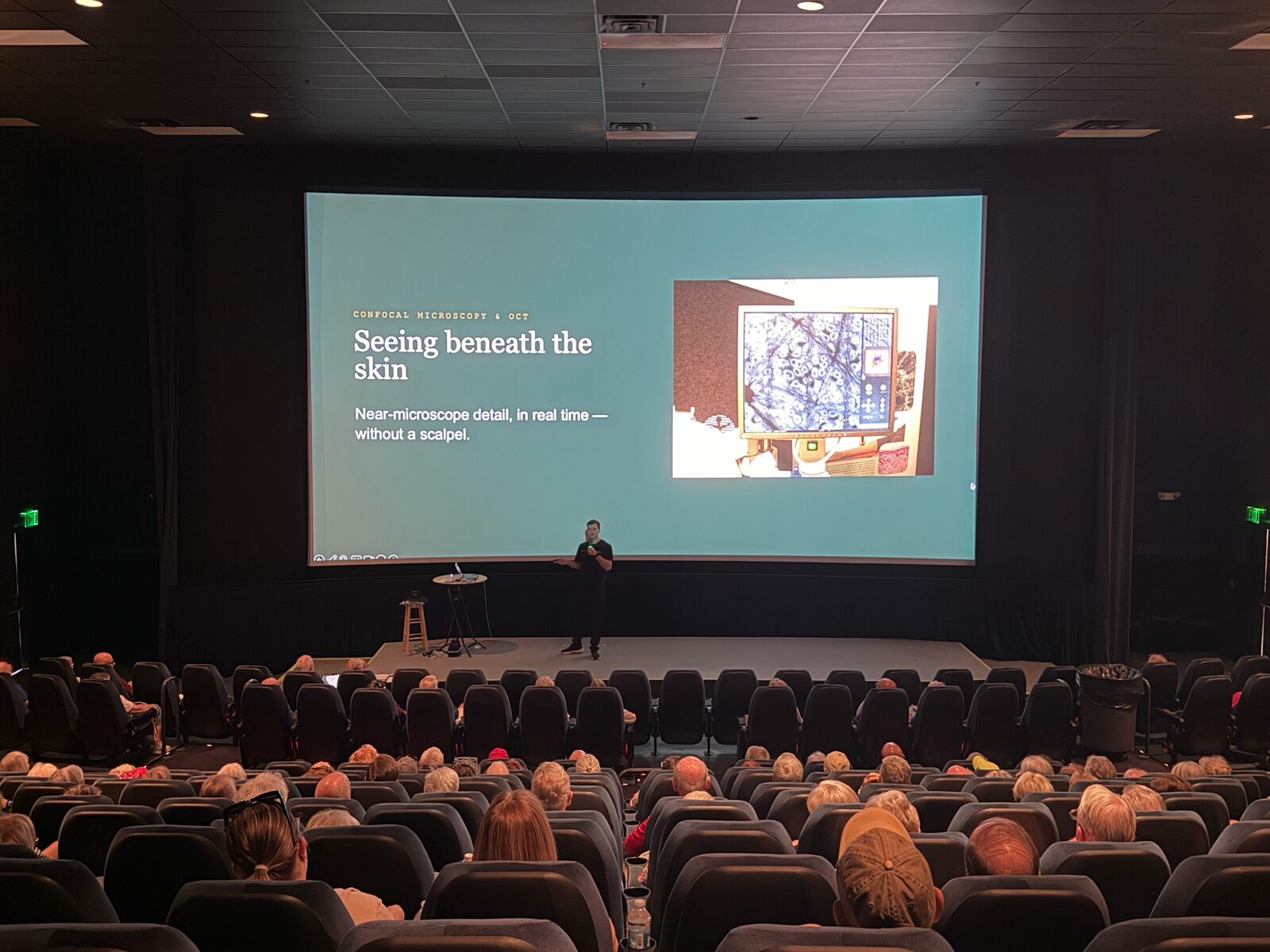
Why skin cancer hits this community harder
Skin cancer is the most common cancer in the United States — about one in five Americans will develop it in their lifetime, and roughly 9,500 people are diagnosed every day.1 Those numbers climb for a community like ours: older, active, and spending the day outdoors in some of the highest UV in the country.
The damage that drives skin cancer accumulates over a lifetime. A childhood up north and decades of Florida sun add up — which is exactly why the people most at risk are often the ones enjoying retirement outdoors. (We wrote more about that here: Why Villages Residents Face a Higher Skin Cancer Risk.)
The three skin cancers — and why early detection changes everything
Most skin cancer falls into three types, and all three are far easier to treat when found early:
- Basal cell carcinoma — the most common, slow-growing, and rarely life-threatening, but it can do real local damage if ignored.
- Squamous cell carcinoma — also common and highly treatable early, with more potential to spread if left alone.
- Melanoma — less common but the most serious. The encouraging part: when melanoma is caught at its earliest, localized stage, the five-year survival rate is about 99%.2
That last figure is the whole point of the talk. Early skin cancer is usually a quick, in-office fix. The cost of waiting is what makes it dangerous.
What to look for: the ABCDEs and the full-body skin check
A simple way to watch your own moles is the ABCDEs:
- Asymmetry — one half doesn't match the other
- Border — edges that are ragged or blurred
- Color — more than one shade, or uneven color
- Diameter — larger than a pencil eraser
- Evolving — changing in size, shape, or color over time
The single most useful habit is a regular full-body skin self-exam — and an annual professional skin check, which looks at the places you can't easily see yourself.
The surveillance gap: why your memory isn't enough
Here's the problem the talk spent the most time on. Skin cancer detection depends on noticing change — but no one, patient or physician, can reliably remember what dozens of spots looked like a year ago. That's the surveillance gap.
This is where total body photography comes in. At SpotDoc we use a Canfield Vectra WB360 — the only one within 280 miles — to capture 92 photographs in about a second, building a detailed map of your skin. At your next visit, we compare against that baseline so we're evaluating what's actually changing over time, instead of relying on memory. It's the difference between a snapshot and a track record.
Prevention that actually works
The most effective prevention is also the least complicated:
- Daily broad-spectrum SPF 30 or higher, reapplied outdoors
- Sun-protective clothing, a wide-brim hat, and shade during peak hours
- No tanning beds — ever
- An annual professional skin exam
One newer point from the talk: for people with a history of certain skin cancers, nicotinamide — a form of vitamin B3 — has been shown in research to lower the rate of new skin cancers and now appears in national treatment guidelines. It isn't right for everyone, so ask your dermatologist whether it makes sense for you.
Couldn't make it? Bring your questions to us
Some of the best moments of the evening came during the Q&A. If you have a question we didn't answer — or a spot you've been meaning to have looked at — that's exactly what we're here for. If you're overdue for a baseline skin check, you can book a scan online or call us at (352) 914-3451.
Thank you to the VHA and to everyone who came out. We'll see you at the next one.
References
-
Skin Cancer Foundation — Skin Cancer Facts & Statistics. skincancer.org ↩
-
American Cancer Society — Survival Rates for Melanoma Skin Cancer. cancer.org ↩